Back to insights
Article/ Compliance
The EU's New Hazard Classes After 1 November 2026: What Ended, and What Did Not Follow
20 min read
ChemAbout Insight · EU CLP hazard classes for endocrine disruption, PBT/vPvB and PMT/vPvM
Status as of 1 November 2026. This article is general information on EU chemicals legislation; it is not legal advice.
◆ KNOWLEDGE CARD — 5-minute overview
Before You Read
This article is for you if you are:
- Classifying, labelling or writing safety data sheets for substances placed on the EU market
- Buying or distributing chemicals in the EU and reading suppliers' labels and SDSs
By the end, you will understand:
- What exactly ended on 1 November 2026
- Which records follow a new classification, and on which legal clock
- Why it matters whether a classification is the supplier's or harmonised in Annex VI
One-Sentence Answer
1 November 2026 ended an exemption for old substance stock from the EU's new hazard classes—it did not start them, did not change any substance's REACH status, and arrived before any harmonised entry in those classes, so for now they reach buyers through suppliers' own classifications.
The classes, four of them with eight hazard statements (EUH380 to EUH451), were added to the CLP Regulation in 2023; in June 2026 EU experts recommended, for the first time, an endocrine-disruption classification under them.
Knowledge Graph — the map first
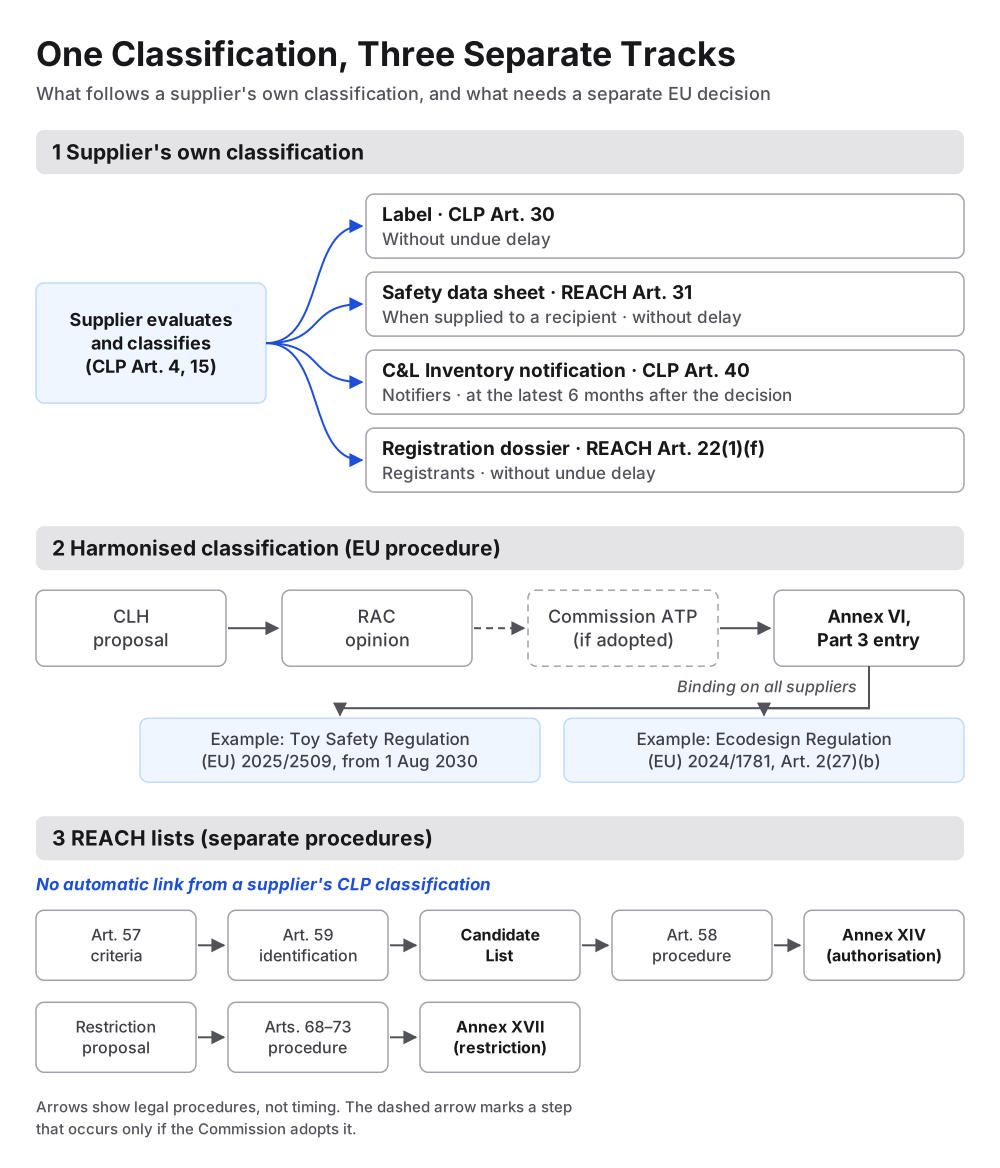
                                   ┌──→ Label (CLP Art. 30)
                                   ├──→ Safety data sheet (REACH Art. 31)
Supplier's own ──→ Main line: ─────┼──→ C&L Inventory notification (CLP Art. 40)
classification     records that    └──→ Registration dossier (REACH Art. 22)
(CLP Art. 4, 15)   follow, each
      │            on its own clock
      │
      ├──→ Harmonised branch: CLH proposal ──→ RAC opinion ··→ Commission ATP (if adopted)
      │                       ──→ Annex VI, Part 3 ──→ binding on all suppliers;
      │                           cited by some laws (toys, ESPR)
      │
      └──→ REACH branch (separate procedures; no automatic link from a CLP classification)
               ├──→ Art. 57 criteria ──→ Art. 59 ──→ Candidate List ──→ Art. 58 ──→ Annex XIV
               └──→ Restriction proposal ──→ Arts. 68–73 ──→ Annex XVII
Three paths lead from this map: the main line (what a supplier's classification sets in motion), the harmonised branch (how a classification becomes binding and reaches other laws) and the REACH branch (separate procedures). The Deep Dive walks all three.
Mental Model
Supplier classification ──→ label · SDS · C&L entry · registration    (supplier duties, separate clocks)
EU decisions            ──→ Annex VI entry · Candidate List · Annex XIV · Annex XVII
A CLP classification is a hazard determination with legal consequences for supplier documents; it is not a REACH listing decision.
◆ INSIGHT ARTICLE — 20–30 minute deep read
Deep Dive
What exactly ended on 1 November 2026?
Fundamental ★★★★★ Must-read
Answer: a transitional allowance for quantities of substances placed on the market before 1 May 2025, not the start of the new classes.
Why:
- The rule applied to new placings from 1 May 2025. For each of the four classes, Delegated Regulation (EU) 2023/707 states that "from 1 May 2025 at the latest, substances shall be classified" under the new criteria (CLP Annex I, sections 3.11.2.4, 4.2.2.4, 4.3.2.5 and 4.4.2.5, as inserted by 2023/707).
- The exemption covered stock, not substance identities. The same sections continue: "substances which were placed on the market before 1 May 2025 are not required to be classified … until 1 November 2026"; the labelling provisions use the same dates. The exemption followed a quantity already placed on the market, not a substance or a product name.
- The text sets no other condition. 2023/707 does not mention formulation; the "unchanged formulation" condition found in some secondary summaries is not in the Regulation.
| Date | What it governs |
|---|---|
| 1 May 2025 | New classes apply to substances placed on the market from this date |
| 1 May 2026 | New classes apply to mixtures placed on the market from this date |
| 1 November 2026 | End of the allowance for substance quantities placed on the market before 1 May 2025 |
| 1 May 2028 | End of the allowance for mixture quantities placed on the market before 1 May 2026 |
Source: CLP Annex I sections 3.11, 4.2, 4.3 and 4.4, as inserted by Delegated Regulation (EU) 2023/707.
The November date matters most to whoever still holds or sells pre-May 2025 stock; for everything placed on the market since then, the obligation was already 18 months old.
What does a label carry when a substance meets a new class?
Fundamental ★★★★☆ Core reading
Answer: an EU hazard statement that works as a main hazard statement, a signal word and precautionary statements, but no new pictogram.
Why:
- The statements carry EUH numbers but the function of H-statements. The eight statements are EUH380/EUH381 (endocrine disruption for human health, categories 1 and 2), EUH430/EUH431 (endocrine disruption for the environment), EUH440/EUH441 (PBT/vPvB) and EUH450/EUH451 (PMT/vPvM). Recital 16 of 2023/707 says they "should function as 'H-statements' ('main' hazard statements)".
- Signal words are assigned. "Danger" for both endocrine-disruption category 1 classes and for PBT, vPvB, PMT and vPvM; "Warning" for the two category 2 classes (2023/707, Tables 3.11.3, 4.2.3, 4.3.1, 4.4.1). Each table also prescribes precautionary statements, for example P201, P202 and P273.
- The classes have no pictogram of their own, because the UN system has none yet. Recital 17 says pictograms "should be added … upon their adoption at the UNGHS". The UN Sub-Committee of Experts on the GHS has these hazards under discussion; none has been adopted into the GHS. A product classified in another hazard class still carries that class's pictogram.
- By default, the label is updated "without undue delay". That is CLP Article 30 as it applied on 9 December 2024, for more severe classifications. Regulation (EU) 2024/2865 replaced it with fixed limits (six months for a new hazard class), but Regulation (EU) 2025/2439 postponed mandatory application of the replacement to 1 January 2028; until then suppliers may apply it early.
The consolidated CLP text of 1 July 2026 on EUR-Lex already prints the six-month Article 30; the application date is set by the amending Regulations, not by the consolidation.
Which other records follow a new classification, and on which clock?
Industry ★★★★★ Must-read
Answer: the SDS, the C&L Inventory entry and, for registered substances, the registration dossier, each under its own trigger; none of the clocks starts on 1 November.
Why:
- A review duty drives all of them. Under CLP Article 15(1), suppliers must take "all reasonable steps" to become aware of new information affecting classification and, where it is "adequate and reliable", re-evaluate "without undue delay".
- The SDS duty itself can be new. REACH Article 31(1)(a) requires an SDS where a substance or mixture "meets the criteria for classification as hazardous" under CLP; the new classes are hazard classes in Parts 3 and 4 of CLP Annex I (CLP Article 3). A substance classified only in a new class, for example only PMT, can therefore create an Article 31(1)(a) duty when it is supplied to a recipient, subject to the Regulation's exceptions, such as Article 31(4) for supply to the general public. (ChemAbout reading of the two articles.)
- The records are tied together. Annex II section 2.1 requires the SDS classification to be "the same as" the one the supplier notified to the C&L Inventory or registered.
- Only the C&L notification has a fixed limit. Since 1 July 2026, CLP Article 40(2) has required an update "at the latest 6 months after a decision to change the classification"; the SDS, label and registration rules say "without delay" or "without undue delay".
| Record | Legal basis | Trigger | Time limit |
|---|---|---|---|
| Label | CLP Art. 30 (as applicable until 31 Dec 2027) | Change in classification or labelling | Without undue delay |
| SDS | REACH Art. 31(9)(a) | New hazard information | Without delay; to recipients of the previous 12 months |
| C&L Inventory | CLP Art. 40(2) (from 1 Jul 2026) | Decision to change classification | At the latest 6 months |
| Registration | REACH Art. 22(1)(f) | Change in classification and labelling | Without undue delay |
Sources: CLP Articles 15, 30 and 40; Regulations (EU) 2024/2865 and 2025/2439; REACH Articles 22 and 31.
The triggers differ—new information, a decision, a change—and none of them is a calendar date.
Procurement Insight: Article 31(9) requires a revised SDS to be sent to recipients supplied during the preceding 12 months; it imposes no such distribution duty for earlier recipients.
Why does one SDS describe the same hazard in two vocabularies?
Advanced ★★★★☆ Core reading
Answer: the SDS format in force was written in 2020, three years before the new hazard classes, and its fixed sections still use REACH's older categories.
Why:
- The format predates the classes. REACH Annex II, the legal format of the EU SDS, is the text set by Commission Regulation (EU) 2020/878, applying from 1 January 2021. No later amendment appears in the consolidated REACH text of 22 June 2026, and none addressing the new classes had been formally tabled as of 1 November 2026, as far as this review found.
- Section 2.1 takes the new classification automatically. It requires "the classification … which results from the application of the classification criteria" in CLP, so a classification in a new class appears there, with its EUH statement and signal word in section 2.2.
- Section 2.3 still asks the older questions: whether the substance is PBT or vPvB "in accordance with Annex XIII", and whether it is on the Candidate List for endocrine-disrupting properties or identified as an endocrine disruptor under the biocides and plant-protection criteria (Regulations (EU) 2017/2100 and 2018/605). PMT/vPvM, which has no REACH counterpart, has no named place there.
- Section 12 follows section 2.3. Subsection 12.5 reports "the results of the PBT and vPvB assessment as set out in the chemical safety report"; subsection 12.6 covers endocrine-disrupting effects on the environment "for the substances identified as having endocrine disrupting properties in subsection 2.3".
- The on-request trigger was not updated either. REACH Article 31(3)(b), on SDSs for some unclassified mixtures, still refers to PBT/vPvB under Annex XIII. Separately, 2023/707 amended CLP Annex II section 2.10, so that an unclassified mixture containing at least 0.1% of a category 2 endocrine disruptor carries EUH210, "Safety data sheet available on request". The two provisions are different instruments, not one amendment.
The PBT criteria in CLP mirror those of REACH Annex XIII (recital 14 of 2023/707), so for PBT/vPvB the two descriptions use closely aligned criteria; for endocrine disruption and PMT/vPvM, the fixed sections have no direct counterpart.
On the same SDS, section 2 can speak CLP's 2023 vocabulary while sections 2.3 and 12 speak REACH's 2020 vocabulary—overlapping but not identical definitions of related hazards. The absence of a matching subsection does not by itself make an SDS incomplete; relevant available information still belongs in the appropriate sections.
Why does it matter whether a classification is the supplier's or harmonised?
Industry ★★★★★ Must-read
Answer: a harmonised entry binds every supplier and is what the product laws reviewed here cite; for the new classes, none was in force as checked on 1 November 2026.
Why:
- Annex VI held no entry in the new classes. In the consolidated CLP text of 1 July 2026, the new classes appear only in the list of hazard-class codes in Part 1 of Annex VI; the table of harmonised entries in Part 3 contains none of the codes EUH380 to EUH451. No ATP adding such an entry had been published as of 1 November 2026; the next Annex VI ATP on record, Regulation (EU) 2025/1222, applies from 1 February 2027.
- Opinions now exist, but an opinion is not an entry. At its 77th meeting (1–5 June 2026), ECHA's Risk Assessment Committee (RAC) adopted opinions classifying resorcinol as an endocrine disruptor for human health, category 1 (EUH380)—RAC's first such recommendation—and trifluoroacetic acid (TFA) and its inorganic salts as PMT and vPvM, as well as toxic to reproduction (Repr. 1B, H360Df). They become law only if the Commission adopts them in an Adaptation to Technical Progress (ATP) amending Annex VI.
- A harmonised entry ends the supplier's discretion for that class (CLP Article 15(4)). Until then, each supplier classifies on its own evaluation; since 1 July 2026, a notifier diverging from the most severe classification in the C&L Inventory has had to give its reason (CLP Article 40(1)(g)). Giving a reason does not validate the divergence.
- The two laws reviewed here that expressly incorporate the new classes—toys and ESPR—key on Annex VI Part 3. (ESPR also has a separate Candidate List branch, Article 2(27)(a).)
| Act | How it refers to the new classes | Self-classification enough? | Applies |
|---|---|---|---|
| Toy Safety Regulation (EU) 2025/2509, Annex II Part III point 4 | Prohibits substances "classified in Part 3 of Annex VI" as endocrine disruptors for human health, category 1 or 2 | No | 1 August 2030 |
| Ecodesign for Sustainable Products Regulation (EU) 2024/1781, Art. 2(27)(b) | Defines "substance of concern" to include substances classified in Part 3 of Annex VI in the ED, PBT/vPvB and PMT/vPvM classes | No | Through product-specific ecodesign acts |
| Cosmetic Products Regulation (EC) No 1223/2009, Art. 15 | Refers to CMR classifications in Part 3 of Annex VI; the new classes are not named | Not applicable | In force |
| Waste HP 14 "Ecotoxic", Regulation (EU) 2017/997 | Lists H420, H400 and H410–H413; the new EUH codes are not named | Not applicable | In force |
Sources: the acts listed, read in their Official Journal versions.
Until a new-class entry applies in Annex VI, these acts do not reach products through the new classes.
Market Insight: The signals that the new classes are acquiring reach beyond supplier documents are public: draft ATPs, which the Commission notifies to the WTO, and ECHA's registry entries for resorcinol and TFA.
Does a new CLP classification change a substance's REACH status?
Fundamental ★★★★☆ Core reading
Answer: not by itself; Candidate List, authorisation and restriction status each require their own REACH decision.
Why:
- REACH's SVHC criteria cite CLP for some hazards only. Article 57 points (a) to (c) refer to the CLP classes for carcinogenicity, mutagenicity and reproductive toxicity, categories 1A and 1B. Points (d) and (e) refer to the PBT and vPvB criteria of REACH Annex XIII. Point (f) covers substances "such as those having endocrine disrupting properties" where there is evidence of "an equivalent level of concern", identified "on a case-by-case basis" under Article 59.
- Identification is a procedure, not a consequence. A substance enters the Candidate List only by an Article 59 decision; inclusion in Annex XIV follows the Article 58 procedure; restrictions follow Articles 68 to 73.
- The two procedures have already diverged on one substance. On 12 June 2020, ECHA's Member State Committee did not reach unanimity on France's proposal to identify resorcinol as an SVHC for endocrine disruption and referred the majority and minority views to the Commission under Article 59(9). ECHA's records still showed the case as ongoing, at the Member State Committee stage of 12 June 2020, and resorcinol was not on the Candidate List, as checked on 1 November 2026. In June 2026, RAC adopted a CLP opinion classifying it as an endocrine disruptor for human health, category 1.
A CLP classification answers "does this substance have this hazard?"; REACH's lists answer "what should the EU do about it?"—and they are decided by different committees, on different evidence thresholds.
Procurement Insight: A new EUH380 on a supplier's label is therefore not the same fact as a Candidate List entry. Candidate List obligations, such as the article-information duty under REACH Article 33, are triggered only by the Candidate List itself.
Sidebar: mixtures
Mixtures follow the same structure two years later. Under the component-based route, a mixture is classified in a new class when a component in that class reaches a generic concentration limit: 0.1% for endocrine-disruption category 1, PBT, vPvB, PMT and vPvM; 1% for category 2 (2023/707, Tables 3.11.2 and 4.2.2, sections 4.3.3.1 and 4.4.3.1). For endocrine disruption, data on the mixture itself and bridging principles are alternative routes. With no harmonised component entries in force, the component classifications used are suppliers' own.
Industry Insight
The sections above meet in one period: the time before harmonised entries exist. Each supplier classifies on its own evaluation of evidence that, for endocrine disruption and mobility, is demanding to assess. The C&L Inventory asks a notifier to explain a divergence from the most severe listed classification but does not require it to adopt that classification; each supplier remains responsible for the timeliness and adequacy of its own evaluation. Buyers of the same substance from different suppliers can therefore receive different new-class classifications. (ChemAbout analysis.)
The next question is when that ends. The mechanism is known even where the timing is not: RAC opinions go to the Commission, which may adopt ATPs amending Annex VI, each with its own application date. Resorcinol and TFA are now in that pipeline. Until entries like theirs apply, the new hazard classes are implemented mainly through supplier classification and communication duties.
What Surprised Us
A common assumption: the EU's new hazard classes took effect on 1 November 2026. Reality: they applied to substances placed on the market from 1 May 2025; 1 November ended an exemption for older stock.
A common assumption: the consolidated text on EUR-Lex shows the rule that applies today. Reality: the 1 July 2026 consolidation of CLP prints a six-month label-update rule that does not become mandatory until 1 January 2028.
Continue Exploring
Follow the main line: What a safety data sheet can—and cannot—establish in chemical trade
Follow the REACH branch: REACH in 2026: two new SVHCs and a PFAS foam deadline · How the 2,4-DNT restriction reaches articles
Follow the harmonised branch: PFAS regulation in 2026: what changes for the chemical industry
Evidence Notes
Evidence grading (applied consistently across the ChemAbout article series) [A] Academic Literature — peer-reviewed academic journals. [B] Official Documents — official or legally authoritative records (legislation, regulatory publications, official standards and guidelines). [C] Industry Sources — trade-association reports, company disclosures, or market research. [D] ChemAbout Inference — reasoning specific to this article, built on [A]/[B]/[C] evidence above, not an independently verified result.
Key Facts
- Delegated Regulation (EU) 2023/707 inserts four hazard classes into CLP Annex I: endocrine disruption for human health (3.11) and for the environment (4.2), PBT/vPvB (4.3) and PMT/vPvM (4.4) [B].
- Hazard statements EUH380, EUH381, EUH430, EUH431, EUH440, EUH441, EUH450, EUH451; signal word "Danger" for category 1 and for PBT, vPvB, PMT, vPvM, "Warning" for category 2; no pictogram (2023/707, label-element tables; recitals 16–17) [B].
- PBT/vPvB criteria in CLP mirror REACH Annex XIII section 1 (2023/707, recital 14) [B].
- Mixture generic concentration limits: 0.1% (ED category 1, PBT, vPvB, PMT, vPvM); 1% (ED category 2) [B].
Industrial Map
- Classification duty: manufacturers, importers and downstream users (CLP Article 4(1)); review duty: CLP Article 15(1) [B].
- Records that follow: label (CLP Art. 30), SDS (REACH Art. 31), C&L notification (CLP Art. 40), registration (REACH Art. 22(1)(f)) [B].
- That a substance classified only in a new class can create a REACH Article 31(1)(a) duty when supplied to a recipient is this article's reading of that Article with CLP Article 3 [D].
- That suppliers of the same substance can issue different new-class classifications before a harmonised entry exists, each remaining responsible for its own evaluation, is this article's reading of CLP Articles 15 and 40 [D].
Regulatory Status
- Transitional dates: substances 1 May 2025 / 1 November 2026; mixtures 1 May 2026 / 1 May 2028 (CLP Annex I as amended by 2023/707) [B].
- 2023/707 also adds two indents to CLP Annex II Part 2 section 2.10 (EUH210 for mixtures with ≥0.1% of a category 2 endocrine disruptor) [B].
- Regulation (EU) 2025/2439 (26 November 2025) amends the application dates of Regulation (EU) 2024/2865: the replacement of CLP Article 30 becomes mandatory on 1 January 2028, with voluntary early application permitted; the Article 40 amendments apply from 1 July 2026; it does not amend 2023/707 [B].
- Omnibus VI (procedure 2025/0531(COD)): European Parliament first-reading decision on the agreed text on 22 October 2026; status unchanged on 1 November 2026, "Awaiting Council's 1st reading position"; not in force [B].
- REACH Annex II: as set by Regulation (EU) 2020/878; no later amendment in the consolidated REACH text of 22 June 2026, and no amending act published since (checked 1 November 2026) [B].
- Annex VI Part 3: no entry with a new-class code in the CLP consolidation of 1 July 2026; the next Annex VI ATP on record, Regulation (EU) 2025/1222, applies from 1 February 2027 and contains none; no later act amending CLP published (checked 1 November 2026) [B].
- RAC-77 (1–5 June 2026): opinions adopted 5 June 2026 on resorcinol (ED HH 1, EUH380; ECHA: "recommending for the first time a classification as an endocrine disrupting substance for human health") and on TFA and its inorganic salts (Repr. 1B, H360Df—category 1B for development, category 2 for fertility; PMT, EUH450; vPvM, EUH451); no ATP recorded in ECHA's CLH registry as of 1 November 2026 [B].
- Resorcinol: Member State Committee opinion of 12 June 2020, no unanimity, final decision under REACH Article 59(9); ECHA SVHC-identification record: case "Ongoing", current stage "SVHC MSC agreement" (12 June 2020), Candidate List inclusion decision still a future step; not on the Candidate List (253 entries, latest inclusion 4 February 2026; searched by name, CAS and EC number) as checked on 1 November 2026 [B].
- UN GHS: the Sub-Committee placed endocrine disruption, PBT/vPvB and PMT/vPvM in its work programme as "potential hazard issues" (ST/SG/AC.10/C.4/86, 2022); a July 2025 status report on endocrine disrupters records that "further work is needed"; the eleventh revised GHS (2025) contains no such hazard classes [B].
Supply Chain Notes
- No statistic was found on how many C&L Inventory notifications use the new classes; this article makes no claim about uptake.
Sources & Method
- EU legal texts were read in their Official Journal or official consolidated versions retrieved from the EU Publications Office: 2023/707; CLP consolidated 1 July 2026; 2024/2865; 2025/2439; 2025/1222; REACH consolidated 22 June 2026; 2020/878; 2025/2509; 2024/1781; 1223/2009; 2017/997.
- The procedural status of Omnibus VI was read from the European Parliament's Legislative Observatory.
- ECHA committee, registry and Candidate List records and UNECE documents were read in their official versions.
- Written in October 2026; Annex VI, ATP, Candidate List and Omnibus VI status change, and the dates above record when each was checked.
Source References
European Union — legislation
- Commission Delegated Regulation (EU) 2023/707 (new hazard classes)
- Regulation (EC) No 1272/2008 (CLP), consolidated text of 1 July 2026
- Regulation (EU) 2024/2865 amending CLP
- Regulation (EU) 2025/2439 amending Regulation (EU) 2024/2865 as regards dates of application
- Commission Delegated Regulation (EU) 2025/1222 (Annex VI ATP, applying from 1 February 2027)
- Regulation (EC) No 1907/2006 (REACH), consolidated text of 22 June 2026
- Commission Regulation (EU) 2020/878 amending Annex II to REACH
- Regulation (EU) 2025/2509 on the safety of toys
- Regulation (EU) 2024/1781 (Ecodesign for Sustainable Products)
- Regulation (EC) No 1223/2009 on cosmetic products
- Commission Regulation (EU) 2017/997 (HP 14 "Ecotoxic")
European Chemicals Agency
- ECHA — Meetings of the RAC, 2026 (RAC-77, 1–5 June 2026)
- ECHA Weekly — 10 June 2026
- ECHA CLH registry — resorcinol
- ECHA CLH registry — trifluoroacetic acid
- ECHA CLH registry — sodium trifluoroacetate and other inorganic salts of trifluoroacetic acid
- ECHA — ECHA recommends TFA's classification as a reprotoxic substance (ECHA/NR/26/28, 6 October 2026)
- ECHA Member State Committee — opinion on the identification of resorcinol as an SVHC (12 June 2020)
- ECHA — Resorcinol not identified as a substance of very high concern (ECHA/NR/20/20, 16 June 2020)
- ECHA — Registry of SVHC intentions until outcome
- ECHA — Candidate List of substances of very high concern
International
- UN GHS Sub-Committee — report of its forty-third session (ST/SG/AC.10/C.4/86, 19 December 2022)
- UN GHS Sub-Committee — status report on the workstream on endocrine disrupters (UN/SCEGHS/48/INF.32, 2 July 2025)
- UNECE — GHS, eleventh revised edition (ST/SG/AC.10/30/Rev.11, 2025)
European Union — procedure