Back to insights
Article/ Compliance
A Safety Data Sheet Is Not a Market Passport: What It Can—and Cannot—Establish in Chemical Trade
20 min read
ChemAbout Insight · Safety Data Sheets (SDS) in cross-border chemical trade
Status as of 16 October 2026. This article is general information on how safety data sheets are regulated in the EU, Great Britain, the United States and China; it is not legal advice.
◆ KNOWLEDGE CARD — 5-minute overview
Before You Read
This article is for you if you are:
- Receiving safety data sheets from suppliers in another jurisdiction
- Working in sourcing, quality, regulatory affairs or trading at a chemical importer or distributor
- Issuing one SDS for products sold into several markets
By the end, you will understand:
- What four jurisdictions require an SDS to do
- Why the same 16 headings do not make one SDS compliant everywhere
- Which SDS fields touch on quality, registration, transport and market access without settling them
One-Sentence Answer
A safety data sheet is the principal legally prescribed document for passing a chemical's hazards and safe-handling information to the next holder; it contains fields that bear on quality, registration, transport and market access, but each of those questions is governed by a different legal regime, duty holder and type of evidence, so the SDS on its own does not settle them.
In December 2024, ECHA reported that 35% of the 2,528 safety data sheets checked by inspectors in 28 EU and EEA countries did not comply with the legislation—either the content fell short or no SDS was provided.
Knowledge Graph — the map first
                                   ┌──→ Hazard classification (Sect. 2)
                                   │        └──→ Handling, exposure controls (Sect. 7–8)
Supplier's SDS ──→ Main line: ─────┤
                   hazard          └──→ Composition (Sect. 3) ──→ consistent with classification?
                   communication
      │
      ├──→ Boundary branch: fields that touch other questions
      │        ├──→ Registration number (Sect. 1) ··· registration duty sits with each manufacturer or importer
      │        ├──→ Physical properties (Sect. 9) ··· batch evidence sits in CoA / specification
      │        ├──→ Transport information (Sect. 14) ··· responsibility assigned by the transport regime
      │        └──→ Regulatory information (Sect. 15) ··· permits and registrations are separate regimes
      │
      └──→ Jurisdiction branch: UN GHS model ──→ EU · GB · US · China
                                   same headings, different language, sections, update clocks
Three paths lead from this map: the main line (what an SDS is legally built to do), the boundary branch (the fields that look like proof of something else), and the jurisdiction branch (why a shared format does not mean a shared obligation). The Deep Dive walks all three.
Mental Model
Manufacturer ──→ Importer / only representative ──→ Distributor ──→ Industrial user
     └──────────── SDS passed on with the product, revised as hazards become known ────────────┘
The SDS is designed to circulate along this chain with the product; the questions it is often asked belong to documents and duties that sit elsewhere.
◆ INSIGHT ARTICLE — 20–30 minute deep read
Deep Dive
Each section leads with the answer, then the reasons; the sections can be read in any order.
What is a safety data sheet legally for?
Fundamental ★★★★★ Must-read
Answer: communicating hazards and safe handling to the people who will hold and use a chemical—not certifying the chemical.
Why:
- The UN model defines it that way. The Globally Harmonized System (GHS) states that the SDS "should provide comprehensive information about a substance or mixture for use in workplace chemical control regulatory frameworks", and calls it "product related" (GHS Rev.10, 1.5.1.1). The GHS is a recommendation; it binds no one until a jurisdiction writes it into law.
- EU law repeats the purpose. Under REACH Annex II, the SDS "shall enable users to take the necessary measures" to protect health, safety at work and the environment (0.2.1). The duty to provide one falls on the "supplier", defined as any manufacturer, importer, downstream user or distributor placing the substance or mixture on the market, and is triggered by hazard classification, PBT/vPvB properties or inclusion on the Candidate List (REACH Article 3(32), Article 31(1)).
- US law ties it to the hazard classification. OSHA's Hazard Communication Standard requires chemical manufacturers and importers to obtain or develop an SDS "for each hazardous chemical they produce or import", and requires the preparer to ensure the information "accurately reflects the scientific evidence used in making the hazard classification" (29 CFR 1910.1200(g)(1), (g)(5)).
- China's 2026 law also places it in the sale. The Hazardous Chemicals Safety Law, in force since 1 May 2026, requires producers and importers to provide a Chinese-language SDS matching the hazardous chemical, and producers and traders to provide a compliant SDS to the buyer at sale (Articles 31 and 57; see ChemAbout's article on the law's wider obligations).
The triggers differ—hazard classification, PBT/vPvB or Candidate List status in the EU, the point of sale in China—but across the four regimes the SDS is primarily a hazard- and safe-use communication document, not a certification of the transaction or the batch.
Why don't the same 16 headings make one SDS valid in every market?
Fundamental ★★★★★ Must-read
Answer: the headings are harmonised; the legal duties attached to them are not.
Why:
- The GHS is built as building blocks. Countries "are free to determine which of the building blocks will be applied" (GHS Rev.10, 1.1.3.1.5.1); its SDS guidance "is dependent on importing countries requirements for SDS" (A4.1.2), and some subheadings are "national or regional in nature" (1.5.3.3.2).
- Language, mandatory sections and update clocks differ, as the table shows. The sharpest case is OSHA, which requires all 16 headings in order but "will not be enforcing information requirements in sections 12 through 15, as these areas are not under its jurisdiction" (29 CFR 1910.1200(g)(2), Note 2).
- The content rules have diverged even between the EU and GB. The EU replaced REACH Annex II with Regulation (EU) 2020/878, applying from 1 January 2021 (older-format SDS allowed until 31 December 2022), which requires, among other things, nanoform information and a place for the unique formula identifier (UFI). The GB Annex II on legislation.gov.uk, checked on 16 October 2026, contains neither provision.
| EU REACH | GB REACH | US OSHA HCS | China HCSL | |
|---|---|---|---|---|
| Who must provide it | Supplier: manufacturer, importer, downstream user or distributor | Same structure | Manufacturer or importer prepares; distributors pass it on | Producer or importer provides; producer or trader provides at sale |
| Language | Official language of the Member State, unless it provides otherwise | English (other languages may be added) | English (other-language copies permitted) | Chinese |
| Sections 12–15 | Required | Required | Not enforced by OSHA | Set by national standards (not reviewed here) |
| Update trigger | New hazard or risk-management information; authorisation; restriction—"without delay", to recipients of the previous 12 months | Same wording | Significant new hazard information—within three months | New hazard property—announce immediately, revise promptly |
| Registration number on the SDS | Required for registered substances | Required (GB registrations) | No registration system under the HCS | Hazardous-chemical registration is a separate filing |
Sources: REACH Articles 3(32), 31(5), 31(9) and Annex II; assimilated REACH Article 31 and Annex II (GB); 29 CFR 1910.1200(g); Hazardous Chemicals Safety Law Articles 31, 57 and 86.
A shared format makes the technical content reusable; it does not by itself establish compliance in another jurisdiction.
Market Insight: The GB and EU texts began from the same Annex II and have since been amended separately. An SDS prepared for one set of requirements cannot be assumed to satisfy the other without checking it against both.
Does a REACH registration number on the SDS show that an import is covered?
Advanced ★★★★★ Must-read
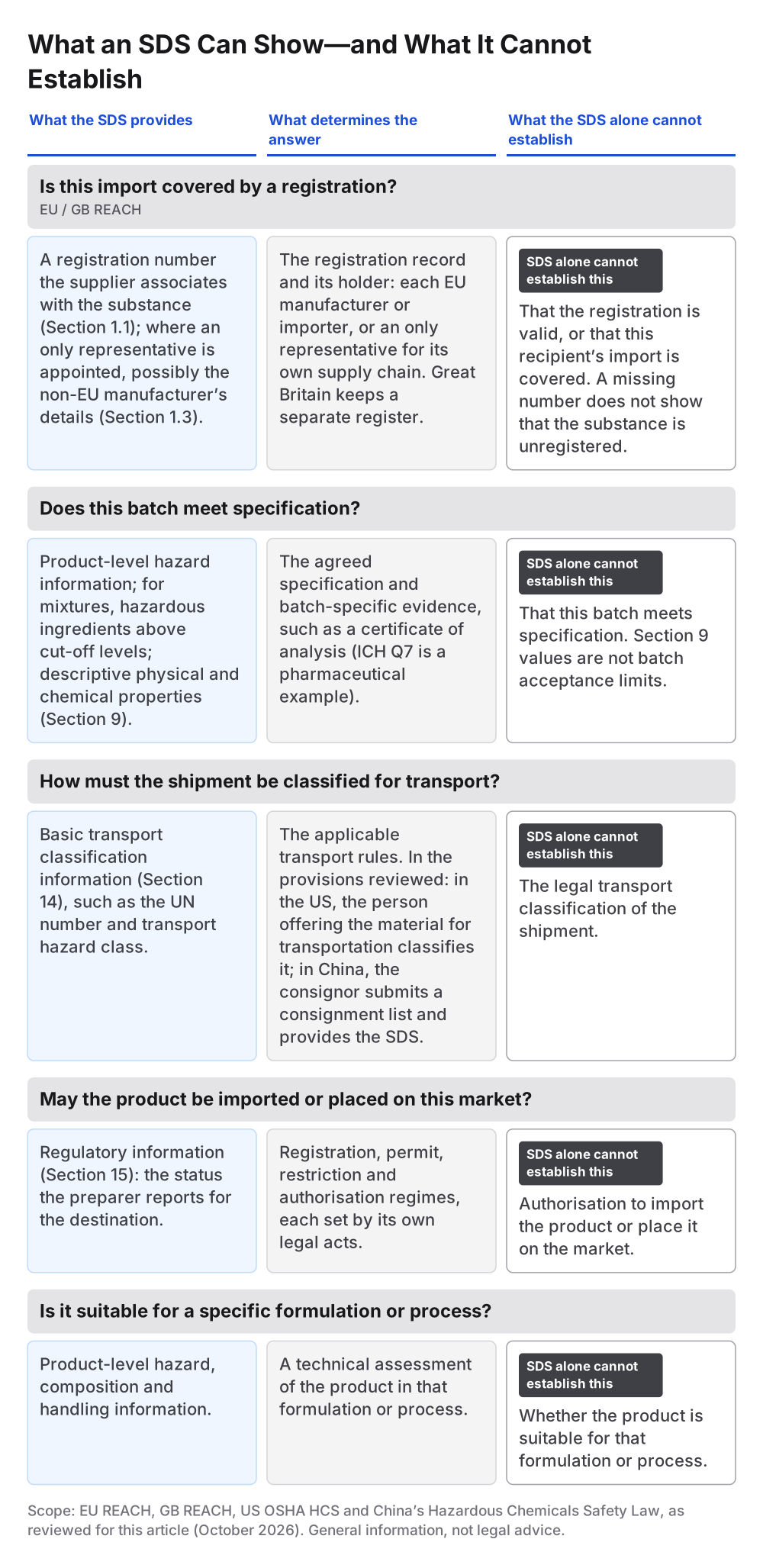
Answer: the SDS provides a registration number associated with the substance; that entry does not, by itself, establish that a particular recipient's import is covered—and the absence of a number does not establish that the substance is unregistered.
Why:
- The SDS must carry the number. For substances subject to registration, REACH Annex II requires the registration number in Section 1.1, and in Section 3 for registered components of mixtures where available (Annex II, 1.1 and 3.2.4).
- The duty to register attaches to each manufacturer or importer. Any manufacturer or importer of a substance in quantities of one tonne or more per year must submit a registration (REACH Article 6(1)).
- A non-EU manufacturer can carry that duty for its importers—but only for its own supply chain. It may appoint an EU-established only representative to fulfil importers' obligations; importers "within the same supply chain" are then regarded as downstream users (Article 8(1)–(3)). Whether a given import falls inside that arrangement depends on the representative's coverage, which Annex II does not require the SDS to state.
- The number may be deliberately incomplete. A distributor or downstream user may omit "the part of the registration number referring to the individual registrant of a joint submission", provided it can supply the full number to enforcement authorities on request (Annex II, 1.1).
- The SDS can still carry relevant information. Where an only representative has been appointed, Section 1.3 may also give details of the non-EU manufacturer (Annex II, 1.3). That is information about the arrangement, not confirmation that a particular import is within it.
The limit runs both ways. A missing number does not establish that a substance is unregistered: registration applies from one tonne per year, and REACH requires an SDS only for substances and mixtures that meet its hazard-based triggers (Articles 6(1) and 31(1)).
The same structure applies in Great Britain, under a separate register. The GB Annex II requires the number assigned under GB REACH; an EU registration number on an SDS does not establish GB registration, and the reverse is also true.
The entry tells the reader which registration the supplier associates with the substance; the recipient's question is usually whether its own import is covered.
Procurement Insight: What the entry presents is identity—a number the supplier associates with the substance described. Whether that registration is valid, and whom it covers, are facts held in the registration and only-representative arrangements, not in a field the SDS must complete.
Can an SDS show that a batch meets specification?
Industry ★★★★☆ Important
Answer: no provision reviewed for this article asks an SDS to state a specification or describe a batch.
Why:
- The SDS is product-level by design. The GHS calls it "product related" (1.5.1.1); one SDS may even cover several similar mixtures or several minor variants of a substance (29 CFR 1910.1200(g)(4); GHS A4.3.1.1).
- Composition is reported for hazard purposes. For mixtures, the GHS asks for hazardous ingredients present above their cut-off levels; listing other ingredients is optional (A4.3.3.2.1). An SDS can therefore be complete and still say nothing about the impurities a buyer's specification controls.
- Section 9 describes the material; it does not set limits. Its values are descriptive physical and chemical properties, relevant to hazard assessment and safe handling. Their appearance on an SDS does not make them batch acceptance limits. (ChemAbout analysis.)
- Batch evidence lives in a different document. The clearest written example is pharmaceutical GMP: ICH Q7 expects a certificate of analysis for each batch of an active pharmaceutical ingredient or intermediate, listing each test, its acceptance limits and the numerical results, signed by the quality unit (11.40–11.43), and expects supplier approval to rest on evidence beyond the certificate (7.31). ICH Q7 is a pharmaceutical guideline, cited as an example of where batch evidence sits, not as a rule for all chemical trade.
For the same reason, an SDS on its own cannot establish whether a product is suitable for a particular formulation or process.
Engineering Insight: "Same CAS number, same SDS" and "same quality" are different statements. The first concerns identity and hazard; the second concerns impurity profile and batch-to-batch consistency, which the SDS is not designed to carry.
Is Section 14 a transport classification?
Industry ★★★★☆ Important
Answer: it gives "basic classification information" for transport; in the US and Chinese provisions reviewed here, transport duties rest with the person offering or consigning the goods, independently of what Section 14 says.
Why:
- The texts use the word "basic". The GHS says Section 14 "provides basic classification information" for transport (A4.3.14); EU Annex II uses the same phrase and lists UN number, proper shipping name, hazard class and packing group.
- US hazardous-materials law assigns classification to the offeror. A person offering a hazardous material for transportation "shall class and describe the hazardous material" under the hazardous-materials regulations (49 CFR 173.22(a)(1)). OSHA, for its part, does not enforce SDS Section 14.
- China's law requires the consignor to provide both documents. A consignor of hazardous chemicals must submit a dangerous-goods consignment list to the carrier—stating the type, quantity, hazard properties and emergency measures—and provide the SDS (Hazardous Chemicals Safety Law, Article 82).
Section 14 records the supplier's statement of the transport classification; in the provisions reviewed, the transport rules assign responsibility for it separately.
What does Section 15 say about market access?
Industry ★★★☆☆ Context
Answer: it reports regulatory status; it is not an authorisation to import or place the product on the market.
The GHS asks Section 15 for the regulatory status of the substance or mixture, including prohibitions or restrictions "in the country or region into which it is being supplied" (A4.3.15.1). Market access itself is decided elsewhere. In the EU, substances may not be manufactured or placed on the market unless registered where required (REACH Article 5); in China, producers and importers file a hazardous-chemical registration with the registration body designated by the State Council's emergency-management department, a duty distinct from the SDS duty (Hazardous Chemicals Safety Law, Article 86). Restrictions arrive by their own legal acts—recent examples include new REACH Candidate List entries and the 2,4-DNT restriction—and a restriction then triggers an SDS update (Article 31(9)(c)), not the other way round. In none of the four regimes reviewed is the SDS itself a permit. (ChemAbout analysis.)
What can reading an SDS as connected evidence reveal?
Advanced ★★★★☆ Important
Answer: internal contradictions, which the law itself prohibits—but not an SDS that is consistently wrong, or one that describes a different material from the one delivered. (ChemAbout analysis.)
Why:
- The law builds in cross-links.
- EU Annex II requires the SDS to be consistent with the registration and the chemical safety report (0.1.2).
- It forbids statements such as "harmless" or anything "inconsistent with the classification" (0.2.4).
- Each listed mixture component must be given with its own classification (3.2).
- OSHA requires the SDS to reflect the evidence behind the hazard classification ((g)(5)).
- Inspectors found those links broken in part of the inspected sample. In the EU's REF-11 enforcement project (report dated December 2024), ECHA's announcement reports data-quality deficiencies in 27% of the inspected SDS; in the project report, 513 of the 1,883 SDS for which inspectors gave an indication of quality issues were reported as containing incorrect or implausible information. The report names deficiencies most often in sections 3, 8 and 9, and frequently in sections 1 and 2. Its recurring issues include mixture classifications not consistent with the ingredients and their classification, Section 9 information inconsistent with the listed ingredients, and toxicology data in contradiction with the classification.
- Newer content requirements were often missing. ECHA's announcement reports nanoform information missing in 67% of the SDS where it was required, endocrine-disruption information in 48%, and required exposure scenarios in 18%.
- Provision is a separate measure. ECHA's announcement states that suppliers provided the SDS when required "in 96 % of the cases"; the project report gives 2,412 of 2,528 SDS (95%) as actively provided to recipients. This measures whether an SDS was supplied, not whether its content complied.
These figures describe the SDS inspectors selected and checked in that project; they are not an estimate of the quality of all SDS in circulation.
A consistency reading tests whether an SDS agrees with itself; it cannot test whether the SDS agrees with the drum. (ChemAbout analysis.)
Procurement Insight: The sections where the REF-11 report found recurring problems—classification, composition, exposure controls and physical-chemical data—are also the sections the law ties to one another. (ChemAbout analysis.) That linkage is what lets an inconsistency show up from the document alone.
What happens when one SDS is asked to answer every question?
Fundamental ★★★☆☆ Illustrative example
This is a hypothetical example, constructed to illustrate the boundaries above. It does not describe a documented case or any real company.
An EU distributor receives an English-language SDS from a manufacturer outside the EU. Section 1.1 presents a REACH registration number; Section 14 gives a UN number and transport class; Section 9 gives a melting point and a density.
That SDS establishes:
- that the manufacturer has classified the product and communicated its hazards;
- which registration number the supplier associates with the substance;
- what the manufacturer considers the transport classification to be.
It does not establish:
- whether that number corresponds to a valid registration, or whether the distributor's own import is covered, which depends on who registered and whether the distributor sits inside an only-representative arrangement;
- whether the next delivery is in specification;
- whether the transport classification is correct for the shipment—a matter the applicable transport rules decide independently of Section 14;
- whether the SDS meets the language requirement of the Member State where the product will be placed on the market.
Industry Insight
Taken together, the sections above describe one document with one primary function under four legal systems: passing hazard and safe-use information from one holder to the next, prepared by an identifiable duty holder, revised when the hazard picture changes, and written in a language the regime prescribes.
Its evidence boundary follows from that function. Identity, registration, transport and regulatory fields are there so the reader can handle the chemical safely and know which other rules apply—not because the SDS is where those rules are satisfied. Registration coverage is settled by registrants and only representatives; batch quality by specifications and certificates of analysis; transport classification under the applicable transport regime; market access by registration, permit and restriction regimes.
Why, then, is the SDS asked to do more? The likely answer is circulation: it is designed to pass along the supply chain with the product, so it is often the document at hand. (ChemAbout analysis.) That circulation is what makes the SDS the supply chain's common hazard-information document—and what makes its evidence boundary worth stating precisely.
What Surprised Us
A common assumption: a standard 16-section SDS can be used in any market. Reality: OSHA does not enforce four of the sixteen sections.
The mistaken inference: a REACH registration number on an SDS means the buyer's import is registered. Reality: the entry identifies a registration the supplier associates with the substance; a distributor may legally omit the part that identifies the registrant, and coverage depends on arrangements the SDS is not required to describe.
Continue Exploring
Follow the jurisdiction branch: China's Hazardous Chemicals Safety Law and what chemical businesses should check
Follow the regulatory branch: REACH in 2026: two new SVHCs and a PFAS foam deadline · How the 2,4-DNT restriction reaches articles
Follow the quality branch: 1,3-Propane sultone: what "battery grade" constrains, and the regulatory record of an SVHC
Evidence Notes
Evidence grading (applied consistently across the ChemAbout article series) [A] Academic Literature — peer-reviewed academic journals. [B] Official Documents — official or legally authoritative records (legislation, regulatory publications, official standards and guidelines). [C] Industry Sources — trade-association reports, company disclosures, or market research. [D] ChemAbout Inference — reasoning specific to this article, built on [A]/[B]/[C] evidence above, not an independently verified result.
Key Facts
- The GHS describes the SDS as providing information "for use in workplace chemical control regulatory frameworks" and as "product related" (GHS Rev.10, 1.5.1.1). The GHS is a non-binding UN model; this article cites the tenth revised edition, the version read for it. The amendments adopted in December 2024 for the eleventh revised edition (ST/SG/AC.10/52/Add.3) do not amend chapter 1.1, chapter 1.5 or annex 4 [B].
- The 16 SDS headings and their order are identical in the GHS, REACH Article 31(6) and 29 CFR 1910.1200(g)(2) [B].
- GHS Section 14 provides "basic classification information" for transport (A4.3.14) [B].
Industrial Map
- Duty holders for providing an SDS: EU and GB—supplier (manufacturer, importer, downstream user or distributor); US—chemical manufacturer or importer, with distributors passing SDS on; China—producer or importer, and producer or trader at sale [B].
- Transport: in the US, the person offering a hazardous material for transportation classes and describes it (49 CFR 173.22(a)(1)); in China, the consignor submits a consignment list and provides the SDS (Article 82) [B]. Other transport regimes were not reviewed.
- Batch quality evidence is assigned to the certificate of analysis and supplier qualification in ICH Q7 (a pharmaceutical GMP guideline), not to the SDS [B]; treating that allocation as general across chemical trade is this article's reading [D].
Regulatory Status
- EU: REACH Article 31 and Annex II as replaced by Regulation (EU) 2020/878 (applying from 1 January 2021; older-format SDS permitted until 31 December 2022). In the consolidated REACH text of 22 June 2026, Articles 3(32), 5, 6, 8 and 31 and Annex II are unchanged from the 23 June 2025 consolidation; the REACH amendments adopted since June 2025 concern Annex XVII and its appendices [B].
- GB: assimilated REACH Article 31 requires English; the GB Annex II text (legislation.gov.uk, checked 16 October 2026) contains no nanoform or UFI provisions [B].
- US: 29 CFR 1910.1200, as revised in 2024 (effective 19 July 2024); OSHA does not enforce SDS sections 12–15 [B].
- China: Hazardous Chemicals Safety Law, adopted 27 December 2025, in force 1 May 2026; SDS duties in Articles 31, 57 and 82; registration in Article 86 [B].
- That a registration number on an SDS does not by itself establish that a registration is valid or that a recipient's import is covered, and that its absence does not establish non-registration, is this article's reading of REACH Articles 6 and 8 and Annex II [D].
Supply Chain Notes
- ECHA announcement, 3 December 2024, on the Forum REF-11 project: 2,528 SDS checked in 28 EU/EEA countries; 35% of inspected SDS non-compliant (content or not provided); data-quality deficiencies in 27%; SDS provided when required "in 96 % of the cases" [B].
- REF-11 project report, December 2024: 2,412 of 2,528 SDS (95%) actively provided; 513 of 1,883 SDS with a quality indication reported as containing incorrect or implausible information [B].
- These figures describe the inspected sample, not all SDS in circulation; the 35% non-compliance and the provision figures are different measures [B].
Sources & Method
- Legal texts were read in their official or official-consolidated versions: EU texts via the EU Publications Office, GB texts via legislation.gov.uk, US texts via eCFR, the Chinese law via the NPC website. GHS text was read from the official UNECE publication of the tenth revised edition.
- The eleventh revised GHS edition (2025) could not be retrieved for this article; its effect on the cited paragraphs was checked against the official amendment document only.
- Penalty regimes, sector approval regimes (food contact, pharmaceutical, cosmetic), transport codes (UN Model Regulations, IMDG, ADR, IATA) and China's national SDS standards were outside the scope of the research.
- Written in October 2026; regulatory texts change, and the dates above record when each was checked.
Source References
International
- UNECE — GHS, tenth revised edition (ST/SG/AC.10/30/Rev.10, 2023)
- UN — Amendments to the tenth revised edition of the GHS (ST/SG/AC.10/52/Add.3, 28 January 2025)
- ICH Q7 — Good Manufacturing Practice Guide for Active Pharmaceutical Ingredients
European Union
- Regulation (EC) No 1907/2006 (REACH), consolidated text of 22 June 2026
- Commission Regulation (EU) 2020/878 amending Annex II to REACH
- ECHA — Compliance of safety data sheets: still room for improvement (3 December 2024)
- ECHA Forum — REF-11 project report on safety data sheets (December 2024)
Great Britain
United States
China