Back to insights
Article/ Compliance
1,3-Propane Sultone as a Li-ion Electrolyte Additive: How It Builds the SEI, What Battery Grade Really Means, and the Regulatory Record
9 min read

1,3-Propane Sultone as a Li-ion Electrolyte Additive: How It Builds the SEI, What Battery Grade Really Means, and the Regulatory Record
If you formulate or source lithium-ion electrolytes, 1,3-propane sultone (PS, CAS 1120-71-4) is one of those additives that shows up in almost every high-voltage or high-temperature cell recipe — and yet the purchase decision is rarely about the molecule itself. It's about grade: moisture, free acid, chloride, and the paperwork that lets the material legally cross a border. This article covers the electrochemistry (why it works), the specification parameters behind "battery grade," and the regulatory record, grounded in peer-reviewed studies and current ECHA/CLP listings rather than datasheet marketing.
What PS does inside the cell: it builds the SEI before the solvent can
The solid electrolyte interphase (SEI) is the thin passivation layer that forms on the graphite anode during the first charge. A good SEI conducts Li⁺, blocks further electrolyte reduction, and stops the cell from continuously consuming itself. The job of a film-forming additive like PS is to be sacrificially reduced first — to build that layer before the carbonate solvents (EC, PC) break down and generate gas.
First-principles calculations support exactly this behavior. In a 2020 ACS Omega study, PS was shown to have a lower LUMO than ethylene carbonate (−0.043 eV vs 0.002 eV) and a more favorable adiabatic electron affinity (−3.29 eV vs −2.95 eV) — both indicating PS captures the first electron more readily than the solvent and is therefore reduced preferentially at the anode surface (Lin et al., ACS Omega 2020, 5(23):13541–13547).
The reduction doesn't run away. The same study traces a two-electron pathway that terminates at a lithiated sulfonate species (denoted Li₂PS) with a positive electron affinity (0.33 eV), meaning the chain self-limits into a stable, sulfur-containing surface film rather than fragmenting endlessly the way EC does. An earlier DFT analysis reached the same qualitative conclusion — PS is reduced prior to propylene carbonate through one- and two-electron processes, yielding stable species including Li₂SO₃ that assemble into an effective SEI (RSC Advances 2012, DOI: 10.1039/C2RA20200J).
The practical payoff formulators care about follows from this: because PS is consumed instead of the carbonate, it suppresses EC reduction and the associated ethene gas generation (Lin et al., 2020) — which is why PS is reached for in cells that need to survive high-voltage operation and elevated-temperature storage without swelling. PS appears in commercial cell electrolyte formulations described in recent battery patents (e.g. USPTO 12,548,802 and 12,469,887), a better indicator of real-world adoption than any single supplier's cycle-life claim.
A note on performance numbers: vendor pages routinely advertise figures like "2000+ cycles at 4.4 V." Such figures are formulation- and cell-specific results, not a property of the additive itself, and they do not appear in the peer-reviewed literature as general characteristics of PS.
What "battery grade" actually constrains
Two lots can both read "≥99.9%" and behave completely differently in a cell, because the parameters that matter for an electrolyte additive are the trace impurities that get consumed at the electrode or catalyze side reactions. The single most important one is water — and the reason is chemical, not cosmetic:
PS reacts with moisture. The International Chemical Safety Card notes that 1,3-propane sultone "reacts with moist air" to produce 3-hydroxypropanesulfonic acid (ICSC #1524). In a sealed electrolyte, that hydrolysis both consumes the additive and generates acidic species that can promote further LiPF₆ decomposition and degrade the SEI. This is why moisture and free-acid limits — not headline assay — are the real gate for battery-grade PS.
Parameters a battery-grade specification should pin down, and why:
| Parameter | Why it matters | How it appears on a battery-grade CoA |
|---|---|---|
| Assay / purity | Baseline, but not sufficient alone | GC or titration assay, typically ≥99.9% for battery grade |
| Water / moisture | Hydrolyzes PS to acid; poisons the SEI | Karl Fischer result on the actual lot (ppm-level limit) |
| Free acid | Attacks SEI, promotes electrolyte decomposition | Acid value / free-acid ppm on CoA |
| Chloride & sulfate | Corrosion, side reactions, current-collector attack | Ion-level limits on CoA |
| Color / APHA | Proxy for oxidation and degradation products | APHA value; PS should be near-colourless |
| Metals (Fe, Na, K, heavy metals) | Catalyze self-discharge and gas | ICP metals panel |
Physically, PS is a low-melting solid (mp ≈ 30–31 °C) that is liquid just above room temperature and is often handled molten (ICSC #1524; ChemicalBook, CAS 1120-71-4). Molecular formula C₃H₆O₃S, molar mass 122.14 g/mol (PubChem CID 14264). Because it sits near its melting point, storage and transport temperature affect both handling and the moisture-pickup risk above; commercial battery-grade material is typically packed sealed and dry, often under inert gas.
In practice, battery-grade lots are documented with a lot-specific Certificate of Analysis reporting Karl Fischer water, free acid, chloride, and color alongside the assay — a generic "≥99.9%" figure alone does not capture the parameters that determine in-cell behavior. Between lots and between producers, the practical difference typically lies in the level of these trace limits — a Karl Fischer water specification of 20 ppm versus 100 ppm — rather than in the headline assay.
The compliance reality: this is a regulated carcinogen, not a commodity solvent
The following is the current regulatory record; it determines who can lawfully receive the material and under what conditions it is handled.
- Carcinogen, Category 1B (CLP). 1,3-Propane sultone is harmonised-classified as a Category 1B carcinogen under the EU CLP Regulation and carries hazard statement H350 ("May cause cancer") (ECHA substance information, EC 214-317-9) — a carcinogenicity hazard accompanied by a genotoxicity concern. Beyond the carcinogenicity classification, SDS versions typically list acute-toxicity and irritation hazards as well; the specific classification is governed by the supplier's SDS and the latest CLP ATP. The ICSC records absorption by inhalation, through the skin, and by ingestion (ICSC #1524).
- SVHC — REACH Candidate List. On the strength of that carcinogenicity, PS is on the REACH Candidate List of Substances of Very High Concern under Article 57(a) (ECHA; Annex XV SVHC identification report, EC 214-317-9). REACH obligations differ between substances and articles: for PS sold as a substance, the relevant instruments are the SDS, CLP labelling, and (where applicable) REACH registration; where PS is present in articles, REACH Article 33 SVHC communication duties can be triggered. Regulatory scope evolves; ECHA maintains the authoritative current listing and any authorisation obligations.
- Occupational exposure under active review. ECHA ran a public consultation on an EU occupational exposure limit (OEL) for 1,3-propane sultone that closed in December 2024, reflecting ongoing regulatory assessment of the substance's occupational exposure risk; a consultation does not itself establish an OEL.
- Handling. Because it hydrolyzes on contact with moisture and is an alkylating agent, the ICSC calls for dry, well-closed storage separated from food/feed, specialist (not domestic) vacuum equipment for spills, and strict controls to avoid taking contamination home on clothing (ICSC #1524).
In summary: PS is legally and widely traded for battery use, and it is at the same time a hazard-classified substance on the SVHC Candidate List. Supply is accompanied by the SDS, labelling, and compliance documentation required under applicable local regulations; whether a shipment is classified as dangerous goods for transport is determined by the applicable transport regulations (IMDG, IATA, ADR). EU-bound material is subject to the applicable REACH provisions described above.
Sourcing 1,3-propane sultone on ChemAbout
The 1,3-propane sultone compound page on ChemAbout carries identifiers, properties, and compliance context, and lists suppliers offering it as a product. Buyers can publish a purchase request specifying target assay, moisture and free-acid limits, and destination country; suppliers can list battery-grade PS with lot-level CoA documentation.
Sources
- Lin et al., "Effect of 1,3-Propane Sultone on the Formation of Solid Electrolyte Interphase at Li-Ion Battery Anode Surface: A First-Principles Study," ACS Omega 2020, 5(23):13541–13547. https://pmc.ncbi.nlm.nih.gov/articles/PMC7301366/
- "Theoretical study of the reductive decomposition of 1,3-propane sultone: SEI forming additive in lithium-ion batteries," RSC Advances 2012, DOI: 10.1039/C2RA20200J. https://pubs.rsc.org/en/content/articlehtml/2012/ra/c2ra20200j
- ECHA, Substance Information — 1,3-propanesultone (EC 214-317-9 / CAS 1120-71-4). https://echa.europa.eu/substance-information/-/substanceinfo/100.013.017
- ECHA, Annex XV SVHC identification report — 1,3-propanesultone. https://chemycal.com/dap/files/annex_xv_svhc_214-317-9_1_3-propanesultone_en.pdf
- International Chemical Safety Card (ICSC) #1524 — 1,3-Propane sultone. https://www.inchem.org/documents/icsc/icsc/eics1524.htm
- PubChem, Propane sultone, CID 14264. https://pubchem.ncbi.nlm.nih.gov/compound/1120-71-4
- U.S. EPA, 1,3-Propane sultone (1120-71-4) Hazard Summary. https://www.epa.gov/sites/default/files/2016-09/documents/1-3-propane-sultone.pdf
Insights
Sourcing or supplying what you just read about?
ChemAbout connects chemical buyers and suppliers worldwide. Tell us what you need, or list what you offer.
Post a purchase request
Free, no sign-up — stays anonymous
List your products
Requires a free company account
Related articles

ArticleChemAbout Editorial Team13 min read
Why Fluorine Chemistry Has Become a Foundation of Modern Industry: From PFAS Regulation to Next-Generation Drugs and Semiconductor Materials
Fluorine is not an ordinary element but a tuning knob for molecular performance - one element that underpins drugs, agrochemicals, semiconductors, and batteries at once. This deep dive traces the C-F bond's performance leverage, why fluorine dominates modern drug design, why NF3/CF4/SF6 are irreplaceable in chip etching, the fluorite-to-HF value chain that four industries share, and why regulating PFAS (a structural, not toxicological, definition) is not the same as opposing fluorine chemistry. Every key fact cited to a primary source. Not compliance advice.
ArticleChemAbout Editorial Team4 min read
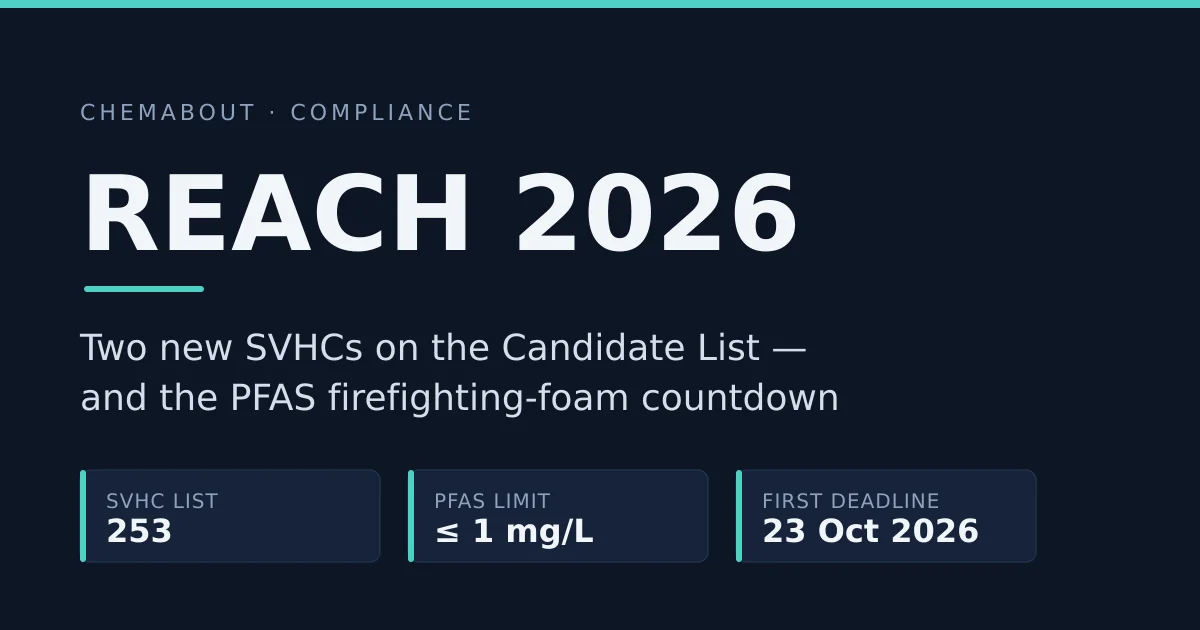
REACH in 2026: Two New SVHCs and a PFAS Foam Deadline Worth Planning For
ECHA added n-Hexane and BPAF to the REACH Candidate List in February 2026, and the EU's PFAS firefighting-foam restriction hits its first hard deadline in October. Here's what to screen, what to ask suppliers, and which dates to put on your sourcing calendar.

ArticleChemAbout Editorial Team24 min read
Semiconductor Materials, PFAS Alternatives, Green Methanol, Advanced Polymers, AI-Designed Catalysts: Five Material Directions Worth Tracking Over the Next Five Years
Between 2024 and 2026, some material directions advanced roughly on schedule — silicon carbide, carbon fiber — while others, like PFAS alternatives, green methanol and AI-designed catalysts, show a real gap between what's been announced and what's actually deployed. This piece separates genuine, dated progress from hype and unproven claims across five materials directions, drawing on English, Japanese and German primary sources.