Back to insights
Guide/ Compliance
China’s Hazardous Chemicals Safety Law Is Now in Force: What Chemical Businesses Should Check
Updated May 31, 20268 min read
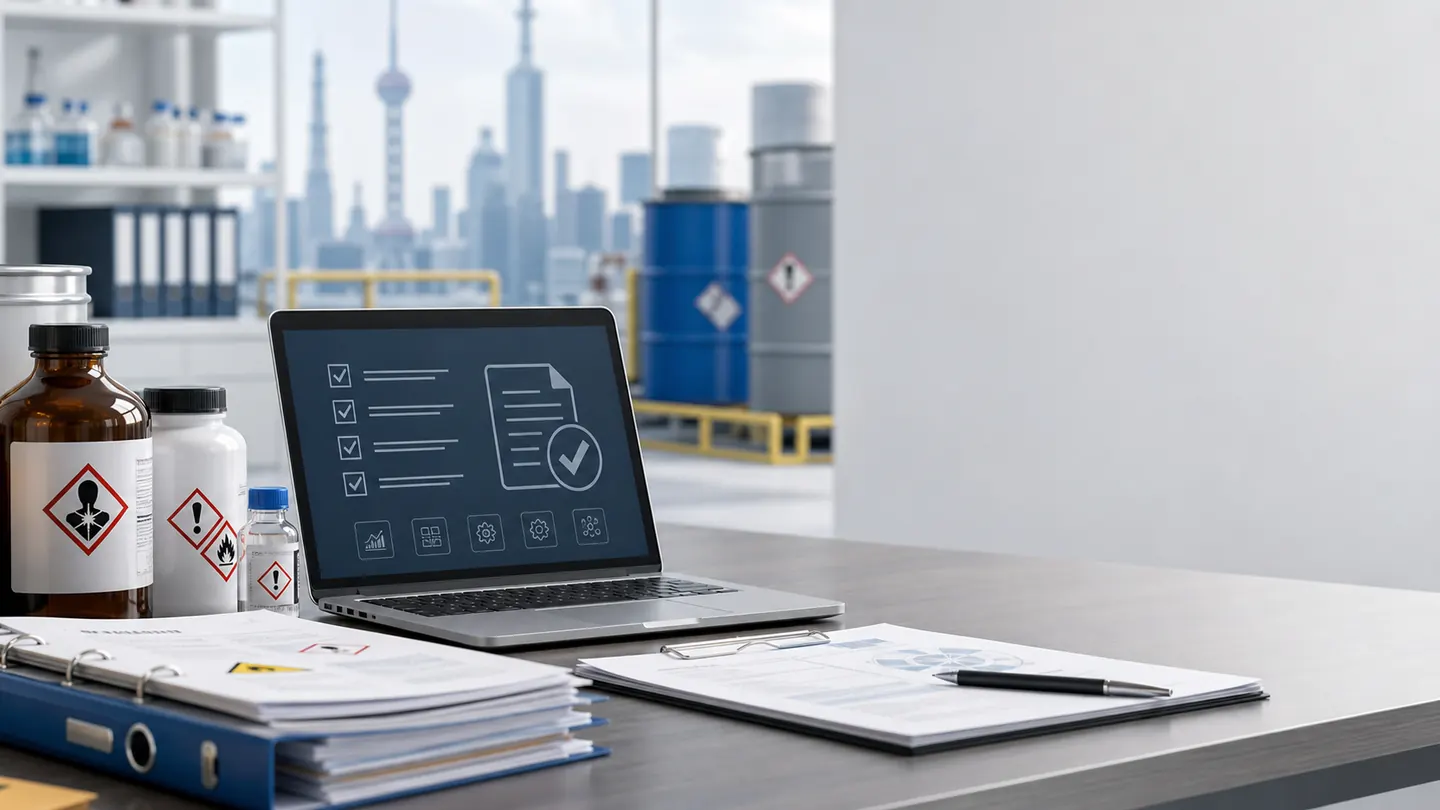
China’s Hazardous Chemicals Safety Law Is Now in Force: What Chemical Businesses Should Check
China’s Hazardous Chemicals Safety Law came into force on May 1, 2026.
For companies that manufacture, import, sell, purchase, use, store, transport, or export hazardous chemicals in China, the main impact is not simply “one more compliance document.” The more practical change is that regulators will expect companies to explain the full responsibility chain: where a hazardous chemical comes from, who it is sold to, how it is stored, how it is transported, and who is responsible if something goes wrong.
In other words, hazardous chemicals compliance in China is moving from isolated document checks toward process management across procurement, production, sales, warehousing, logistics, import, and export.
This article is not legal advice, but it can help chemical companies run an initial compliance self-check.
The law does not only affect manufacturers
When companies hear “hazardous chemicals safety,” many think first of production plants, warehouses, and transport vehicles. But the law reaches a wider range of business activities.
The law applies to the safety management of hazardous chemicals in production, storage, use, operation, and transportation. For companies, this means hazardous chemicals compliance should not be treated as only an EHS department issue.
Procurement teams need to check supplier qualifications and product documentation. Sales teams need to check buyer qualifications and transaction records. Importers need to review Chinese SDS, safety labels, and hazardous chemicals registration. Exporters may also need to consider export control, precursor chemical rules, and other special regulatory requirements.
One point is especially important: hazardous chemicals, dangerous goods, and hazardous waste are not the same concept. A product may be regulated as a hazardous chemical during production or operation, as dangerous goods during transportation, and as hazardous waste during disposal. Companies should not use one label to cover every scenario.
Production and import: SDS, labels, and registration should not be last-minute tasks
For manufacturers, licenses remain the basic entry requirement. A company producing hazardous chemicals must obtain a hazardous chemicals safety production license. If the product is also covered by China’s industrial product production licensing system, an additional industrial product production license may be required.
In practice, however, many problems arise not only from whether a license exists, but from whether licenses, product scope, registration information, SDS, safety labels, and the company’s actual business activities are aligned.
Hazardous chemicals manufacturers and importers are required to complete hazardous chemicals registration. Registration information covers classification and labeling information, physicochemical properties, main uses, hazardous characteristics, storage and use safety requirements, transportation safety requirements, and emergency response measures.
This means registration is not just a standalone filing. It connects with product classification, SDS, labels, packaging, warehousing, transportation, and emergency management.
Importers should prepare especially early. An English SDS or foreign label from an overseas supplier does not automatically satisfy Chinese compliance requirements. Before import, companies should confirm the Chinese SDS, Chinese safety label, hazard classification, packaging information, and registration status instead of waiting until customs clearance or customer requests create pressure.
If a company discovers new hazardous characteristics of a product, it should not continue using outdated documents. The law requires timely revision of SDS and safety labels. For companies importing many products from multiple suppliers and batches, this means SDS and label management needs to be a continuous process, not a one-time file setup.
Sales and operation: selling the product is not the end of responsibility
Hazardous chemicals operation is subject to a licensing system. Without the required license, a company may not operate hazardous chemicals. Operating enterprises also may not purchase hazardous chemicals from manufacturers or operators that do not hold the required qualifications.
This is highly relevant for traders, distributors, and platform-style businesses. In the past, some transactions focused mainly on price, delivery, and payment terms. Under the new law, where the goods come from, who they are sold to, and whether the buyer is qualified to receive or use them all become part of transaction risk.
Sales documentation also matters. When selling hazardous chemicals, manufacturers and operators must provide compliant SDS to the buyer. Hazardous chemicals without SDS or safety labels may not be operated, and companies may not alter SDS or safety labels without authorization.
This means SDS should not be treated as an attachment sent only when a customer asks for it. It is part of the compliance basis for hazardous chemicals sales.
If highly toxic chemicals or explosive precursor hazardous chemicals are involved, the requirements become stricter. Sellers need to verify the buyer’s relevant permits or supporting documents and keep sales records as required. Companies should also pay attention to restrictions on online sales, individual purchases, transfers, and flow management. These products should not be handled like ordinary industrial chemicals.
Procurement: buyers also need front-end compliance checks
Buyers often assume that compliance is mainly the supplier’s or logistics provider’s responsibility. But in hazardous chemicals transactions, if the buyer only looks at price and delivery time, it may bring compliance risk into its own warehouse, production line, and downstream customer relationships.
Before purchasing, companies should ask several questions.
Does the supplier have the required production or operating qualification? Is the product within the company’s permitted purchasing, storage, and use scope? Are the Chinese SDS and safety label complete? Are the product name, CAS number, specification, packaging, hazard classification, and actual use consistent? Is the transportation method compatible with the storage conditions after delivery?
These questions should not wait until after receipt of goods. For imported hazardous chemicals, highly toxic chemicals, explosive precursor hazardous chemicals, or products with special uses, procurement should be reviewed together with EHS, warehousing, logistics, production, and legal teams.
A safer approach is to move hazardous chemicals procurement checks earlier in the process. Before placing an order, complete supplier qualification review, product classification review, SDS and label review, packaging review, transportation review, and storage condition review. This is safer and easier to explain to customers and regulators than trying to fix documents after the product arrives.
Import and export: customs inspection is only one part of the picture
The law makes clear that customs authorities inspect imported and exported hazardous chemicals and their packaging according to law. For importers, this means customs clearance is not the end of compliance. After hazardous chemicals enter China, their storage, use, operation, and transportation must still follow domestic hazardous chemicals safety management requirements.
For exporters, the situation can be more complex. Hazardous chemicals exports may involve safety regulation, customs inspection, dangerous goods transportation, precursor chemical rules, dual-use item rules, and export control requirements.
This does not mean every hazardous chemicals export is subject to export control. But companies should not rely only on the assumption that “this is an ordinary commercial order.”
If a product has sensitive uses, the customer or end user is complex, the destination carries higher risk, or the product may fall within dual-use items, precursor chemicals, or other special regulatory categories, the exporter should complete a more detailed review before shipment. This may include product technical attributes, end user, end use, contract documents, transport route, and destination compliance requirements.
For export teams, hazardous chemicals compliance should not stop at customs documents. It should connect product classification, customer screening, end-use review, logistics planning, and internal approval.
Five self-checks companies can start with
First, rebuild the product list.
Review raw materials, finished products, intermediates, inventory, traded products, and imported products together. Identify which items are hazardous chemicals and which may also involve highly toxic chemicals, explosive precursors, precursor chemicals, key regulated products, or export control risks.
Second, compare licenses, registration, and actual business scope.
Production, operation, import, storage, use, and transportation may trigger different requirements. Companies should confirm whether permits, registration information, actual products, business scope, and operating model are consistent.
Third, review SDS and safety labels.
Focus on whether Chinese SDS, Chinese safety labels, hazard classification, packaging information, product name, CAS number, use, and actual product are aligned. Companies should also assign responsibility for updating documents when new hazardous characteristics are identified.
Fourth, move procurement and sales review to the front end.
On the procurement side, check supplier qualifications, product documents, and storage and transport conditions. On the sales side, check customer qualifications, intended use, flow records, and restrictions for special products. Do not wait until an order is already being executed before making the compliance decision.
Fifth, check the import and export chain separately.
For imports, review Chinese documentation, registration, packaging, customs inspection, and downstream domestic circulation after entry. For exports, review customs inspection, dangerous goods transportation, precursor chemical management, dual-use items, and export control risk.
The real task is connecting the responsibility chain
China’s Hazardous Chemicals Safety Law is now in force. Companies should not treat the response as merely adding a few documents or updating a few labels.
The more important question is whether the company can clearly explain the responsibility chain for hazardous chemicals from procurement, production, import, warehousing, sales, transportation, and export, and whether each step has an executable and traceable process.
If procurement only buys, sales only sells, warehouses only receive, logistics only ships, and EHS only fixes documents afterward, risk will eventually concentrate at one weak point.
A more reliable approach is to embed hazardous chemicals compliance into daily business operations: screen before procurement, verify before sales, confirm before import, review before export, assess before storage and transportation, and update documents when product information changes.
The real message of the law is simple: hazardous chemicals are not ordinary goods. Companies need to know what they are handling and be able to prove that they can manage the risks throughout the business process.
Sources
- Hazardous Chemicals Safety Law of the People’s Republic of China
Insights
Sourcing or supplying what you just read about?
ChemAbout connects chemical buyers and suppliers worldwide. Tell us what you need, or list what you offer.
Post a purchase request
Free, no sign-up — stays anonymous
List your products
Requires a free company account
Related articles

Article4 min read
REACH adds a 2,4-DNT restriction: how one nitrotoluene residue enters the articles compliance boundary
Commission Regulation (EU) 2026/859 adds 2,4-DNT to REACH Annex XVII. The change is narrow but precise: it turns a hazardous substance classification into article-level limits, dates, thresholds and exemptions.
ArticleChemAbout Editorial Team4 min read
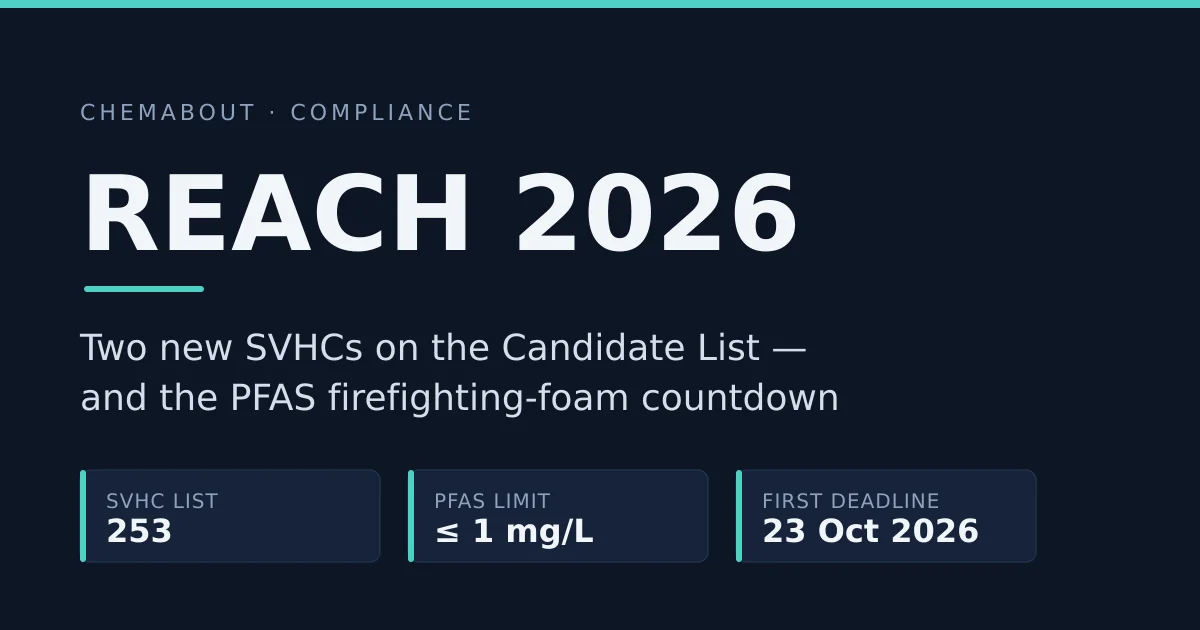
REACH in 2026: Two New SVHCs and a PFAS Foam Deadline Worth Planning For
ECHA added n-Hexane and BPAF to the REACH Candidate List in February 2026, and the EU's PFAS firefighting-foam restriction hits its first hard deadline in October. Here's what to screen, what to ask suppliers, and which dates to put on your sourcing calendar.
Article4 min read
Argentina's recycled plastic content certification: how INTI-ECOPLAS turns recycled content into traceable records
The INTI-ECOPLAS protocol does not treat recycled content as a broad label. It turns the claim into a chain of evidence: minimum percentage, material origin, polymer type, lots, mass records and production documentation.