Back to insights
Article/ Compliance
India's Paraquat Decision: The Law, the Chemistry and the Alternatives
19 min read

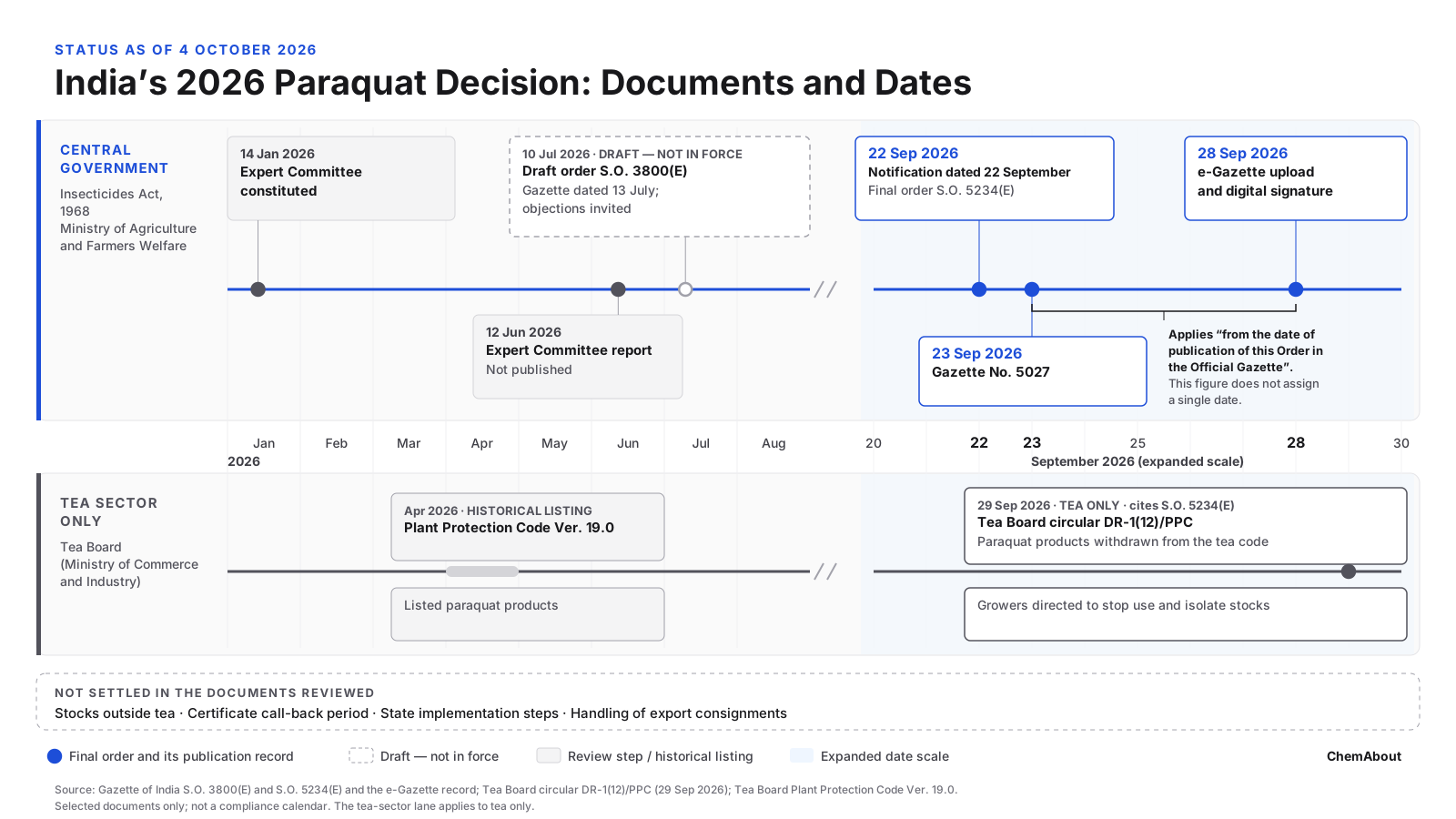
On 22 September 2026, India's Ministry of Agriculture and Farmers Welfare made an order under the Insecticides Act, 1968, that ends the registration of paraquat dichloride. The order prohibits new registrations and cancels the existing certificates of registration "from the date of publication of this Order in the Official Gazette" (S.O. 5234(E)). It followed a July draft that had proposed something broader in its own words: that "no person shall import, manufacture, sale, transport, distribute and use" the herbicide (S.O. 3800(E)).
A registration decision is a legal event with a date. Taking a herbicide out of farming is a slower process of stocks, enforcement, sector rules and replacing the work the herbicide did. This article covers the order, paraquat's uses in India, the chemistry behind its use and hazards, and the evidence on alternatives, with tea as the worked example.
Status as of 4 October 2026. This article describes regulation and evidence; it is not legal advice and not a guide to herbicide use.
What India's Order Actually Changes
The operative text is short. After reciting the July draft and the objections received, S.O. 5234(E) makes four provisions:
- "There shall be a prohibition on the registration of Paraquat Dichloride from the date of publication of this Order in the Official Gazette."
- The certificates of registration granted under section 9 of the Act "shall stand cancelled from the date of publication of this Order in the Official Gazette."
- The Registration Committee "shall call back" the certificates, and anyone who fails to return one faces action under the Act.
- State governments "shall take such steps under the Act and the rules made thereunder, as it may deem fit for implementation of the Order in the State."
The order cites section 27(2) of the Act read with section 28. Section 27(2) lets the central government, after consultation with the Registration Committee, pass an order "including an order refusing to register the insecticide or cancelling the certificate of registration". Section 28 requires that a cancellation be notified in the Official Gazette (Insecticides Act, 1968, India Code text). The Act's "insecticide" includes weedicides added to its Schedule.
Three dates, one legal trigger. The notification is dated 22 September 2026. It appears in Gazette of India Extraordinary No. 5027, dated 23 September 2026, and the copy on the government's e-Gazette portal was uploaded and digitally signed on 28 September. The order takes effect from "the date of publication … in the Official Gazette", not from the date of the notification. This article does not choose between 23 and 28 September. The Tea Board, implementing the order in its sector, cites the Gazette as "No. 5027 dated 23.09.2026" (Tea Board circular, 29 September 2026).
The final order is not the draft. The July draft had a short title, an explicit list of prohibited acts and a deadline for returning certificates. The September order has none of these.
| Element | Draft S.O. 3800(E), 10 July 2026 | Final S.O. 5234(E), 22 September 2026 |
|---|---|---|
| Name | "Banning of Paraquat Dichloride Order, 2026" | No short title |
| Prohibited acts named in the order | Import, manufacture, sale, transport, distribution and use | Registration |
| Existing certificates | Deemed cancelled from the date of the order | Cancelled from Gazette publication |
| Return of certificates | Within three months | Called back; no period stated |
| States | To take necessary steps | To take steps as they deem fit |
| Stocks, sell-through, disposal | Not addressed | Not addressed |
Table 1. The draft and final paraquat orders compared, from the Gazette texts.
Fewer words in the order do not mean fewer legal consequences. The Act links most commercial activity to registration. It prohibits importing or manufacturing an insecticide other than "in accordance with the conditions on which it was registered" (section 17), and makes it an offence to import or manufacture "without a certificate of registration" (section 29). Section 18 provides that no person shall "sell, stock or exhibit for sale, distribute, transport, use, or cause to be used by any worker" an insecticide "which is not registered under this Act". These provisions are framed around registration, so they bear on paraquat once its certificates are cancelled, whether or not the order repeats them. How they are applied to product already in the supply chain is an implementation question, taken up below.
Why the government acted. The draft records that an Expert Committee was constituted on 14 January 2026 to examine "the continued use of or otherwise" of paraquat and reported on 12 June. The Registration Committee noted that paraquat "has been banned or severely restricted in more than 70 countries" and cited "documented adverse health effects; continued history of poisoning incidents and reported high fatalities; the absence of a specific antidote; among others". The final order states that the government is satisfied that paraquat's use "involves risk to human being and animals" requiring immediate action. The committee's report was not found in published form.
What stakeholders are asking. Pesticide Action Network (PAN) India welcomed the order on 29 September but noted that, unlike earlier prohibition orders, it "does not explicitly use the term 'ban' or clearly spell out the prohibition of production, transport, import and use", and does not set a timeframe for recalling certificates or for state implementation. It urged the government to "identify and safely dispose of existing paraquat stocks" and to "prevent further imports and circulation" (PAN India, 29 September 2026). These are the concerns of an advocacy organisation, not an official reading of the order.
The Agricultural Job Paraquat Has Been Doing
Three kinds of evidence describe paraquat's uses, and they should not be merged.
What the label allowed. The Central Insecticides Board and Registration Committee (CIB&RC) publishes a guidance list of approved uses compiled from certificates issued; it states that it is "not for legal purposes". The edition dated 31 May 2022 records paraquat dichloride 24% SL for post-emergence directed inter-row sprays in tea, cotton, rubber, maize, grapes and apple; for coffee; for potato; for pre-plant application under minimum tillage before sowing rice, wheat and maize; and for aquatic weeds in canals and ponds (CIB&RC, Major Uses of Pesticides: Herbicides). That list describes what was registered in 2022. It is not evidence of what is permitted after September 2026.
What research described. A 2016 bulletin from the ICAR-Directorate of Weed Research records that organised tea planters adopted herbicides early, "with 2,4-D in the beginning; and paraquat thereafter", and that "during 1990s, glyphosate started replacing paraquat in tea". Using unpublished industry data for 2007, it reported high paraquat consumption in the tea of Assam and West Bengal and use in sugarcane, cotton and fruit crops in Maharashtra (ICAR-DWR, Herbicide Use in Indian Agriculture, 2016).
What farmers were reported to do. A 2015 field study by PAN India and partner organisations in six states reported paraquat use on about 25 crops, against the nine then on the label, and recorded handling without adequate protection (PAN India, Conditions of Paraquat Use in India, 2015). That is survey evidence from a single organisation at one point in time.
Across these records, paraquat did two broad jobs. It cleared weeds between the rows of established crops, sprayed so as to avoid the crop, and it burned down standing vegetation before sowing where the land was not ploughed. These are different tasks with different alternatives. This article examines the first in one crop, tea, where the official record is unusually complete. It does not assess pre-sowing use in conservation tillage, for which Indian comparative evidence was not assembled for this article.
Tea: where a central decision met a sector rule. India's tea sector runs its own layer of pesticide governance. The Tea Board, under the Ministry of Commerce and Industry, issues a Plant Protection Code (PPC), a policy under which tea research institutes recommend only formulations registered by CIB&RC "with label claim in tea", and which lists approved formulations with the maximum residue limits fixed by the Food Safety and Standards Authority of India. Advisory officers of the tea research institutes and Tea Board development officers check garden inventories against that list (Tea Board, Plant Protection Code, Ver. 19.0, April 2026). Version 19 listed two paraquat products: paraquat dichloride 24 WSC and a premix of paraquat with oxyfluorfen.
On 29 September 2026, citing S.O. 5234(E), the Tea Board withdrew paraquat and paraquat-containing combinations from the code "with immediate effect". The withdrawal concerns paraquat products; it does not remove oxyfluorfen on its own. The circular directed tea plantations, estates, small tea grower collectives, bought-leaf factories and self-help groups "to cease the purchase, transportation, storage, distribution, and application of Paraquat Dichloride", and told growers holding stocks to "isolate them and follow safe/authorized disposal protocols in coordination with the authorized distributors and the State Authorities" (Tea Board circular DR-1(12)/PPC).
The Tea Board circular provides a documented, sector-specific example of the central decision becoming an operating instruction. It records what tea growers were directed to do, not how far the direction has been carried out, and it does not establish implementation in other crops.
The Chemistry Behind Its Use—and Its Risks
Paraquat is 1,1′-dimethyl-4,4′-bipyridinium, sold as the dichloride salt. Its agricultural behaviour and its hazards both follow from the fact that it is a stable dication that readily accepts an electron and gives it away again. The plant and human sides of that chemistry play out in different places and are best kept apart.
In the leaf. The Herbicide Resistance Action Committee places paraquat with diquat in Group 22, "PS I electron diversion" (HRAC Mode of Action Classification 2024). In the chloroplast, paraquat takes an electron that photosystem I would otherwise pass along the photosynthetic chain and is reduced to a radical. The radical hands the electron to oxygen, regenerating paraquat and forming superoxide and other reactive oxygen species; early experiments showed that the herbicidal effect requires oxygen (Bus and Gibson, 1984). Light drives this redox cycling, and the reactive oxygen species it generates damage green tissue. The practical result is what made paraquat useful: "rapid action in light in killing green plant tissue" (Bromilow, 2004).
Its action is concentrated in the green tissue that the spray reaches, which suits burning down what is above ground. Guidance therefore separates it from systemic herbicides, which move through the plant, when perennial weeds with underground organs are the target. The Tea Board's code states that "whenever possible, systemic herbicides should be preferred over contact herbicides", and assigns "difficult to control" weeds such as Imperata cylindrica to "proper systemic herbicide".
In the soil, three different things happen, and they are easy to confuse.
- Adsorption. As a dication, paraquat binds strongly to soil. A 2002 review of long-term field studies reported that the great majority of paraquat reaching the soil under good agricultural practice is strongly adsorbed, in equilibrium with "an extremely low concentration in soil solution" (Roberts, Dyson and Lane, 2002).
- Loss of biological availability. Strong soil binding greatly reduces paraquat's availability for uptake by roots. Bromilow describes paraquat as "active only by direct spray onto plants and not by uptake from soil in which strong binding deactivates it".
- Degradation. Binding is not breakdown. The same review states that paraquat in soil solution is "rapidly and completely mineralized by soil microorganisms"; in long-term trials with repeated high applications, bound residues reached a plateau and then declined. It also notes that total residues measured by "severe extraction procedures" give "no insight" into the amount biologically available.
So "deactivated in soil" means low availability, not absence. A residue detected in soil is not, by itself, evidence of an exposure risk, and low soil activity is not, by itself, a rule about when a crop may be sown. Intervals between application and sowing or harvest are product- and use-specific, and this article does not address them.
Paraquat's farm value and its hazard come from the same property: a molecule that cycles electrons onto oxygen. In a leaf, light drives the cycle and kills the tissue the spray reaches. In the body, cellular reductants drive it, and no specific antidote stops it.
In the body, the mechanism is related but not the same. Human toxicity does not involve photosynthesis. Paraquat is redox-cycled inside cells, generating reactive oxygen species that damage lipids, mitochondria and other cell components in several organs (Gawarammana and Buckley, 2011). It accumulates in the lung, where it is taken up by the polyamine transport system of alveolar cells, so lung concentrations can exceed plasma concentrations several-fold (Dinis-Oliveira et al., 2008). Kidney and liver injury also occur. For poisoning by ingestion, the Indian Society of Critical Care Medicine's 2026 position statement describes high case fatality, with reported rates varying widely between hospital series in India, and states that there is no specific antidote (Gautam et al., 2026). These are clinical outcomes after ingestion, not the risk attached to agricultural exposure. Indian clinicians have also described paraquat as an emerging means of self-harm in agrarian regions, and argue that stronger regulation can help prevent suicides (Singh et al., 2026).
Chronic effects need more careful language. The best-known evidence on Parkinson's disease is observational. In a case-control study nested in the US Agricultural Health Study (110 cases, 358 controls), Parkinson's disease was associated with reported paraquat use (odds ratio 2.5; 95% CI 1.4–4.7) (Tanner et al., 2011). An association in such studies is not, on its own, proof of cause, and the wider epidemiological literature on pesticides and Parkinson's disease includes both significant and inconclusive results (Höllerhage, 2026). India's order rests on acute poisoning, the lack of an antidote and "documented adverse health effects", without specifying chronic outcomes.
Alternatives Must Be Assessed Use by Use
There is no general answer to "what replaces paraquat", because each job asks for a different combination of properties: speed, effect on perennial weeds, crop safety, residual activity, equipment, labour, weather, and registration for that crop and use. The comparison below is limited to tea, where the Tea Board's code gives a documented starting point.
The table describes selected formulations listed in the April 2026 tea code, before paraquat was withdrawn, together with non-chemical practices the code describes. Inclusion here does not establish their current legal availability for a particular use. In particular, this article did not complete a check of glyphosate's legal position at the status date, including the conditions set by a 2022 central order on who may apply it (S.O. 5010(E)); glyphosate and glyphosate premixes are therefore not presented as confirmed current options. The table compares technical attributes. It is not a ranking or a recommendation.
| Formulation or practice in the tea code | Active ingredients and HRAC group | Role described in the code | Technical note |
|---|---|---|---|
| Glyphosate (41 SL, 71 SG, ammonium salt 5 SL) | Glyphosate (9) | Grassy weeds, perennials such as Polygonum and Saccharum, mixed and broadleaf weeds | Site of action: EPSP synthase inhibition |
| Glyphosate premixes | Glyphosate (9) with carfentrazone-ethyl (14); with indaziflam (29); with oxyfluorfen (14) | Mixed weeds; the indaziflam premix for "predominantly monocot and broad leaf" weeds | Separate products, each pairing glyphosate with a partner acting at a different site |
| Glufosinate-ammonium 13.5 SL | Glufosinate-ammonium (10) | Broadleaf and grassy weeds | Site of action: glutamine synthetase inhibition |
| Glufosinate-ammonium + oxyfluorfen premix | Glufosinate-ammonium (10) and oxyfluorfen (14) | Mixed weeds | Two modes of action in one product |
| Oxyfluorfen 23.5 EC | Oxyfluorfen (14) | "In young teas, pre-emergent herbicides like oxyfluorfen should be used" | Cited here for pre-emergence control in young tea; a different task from clearing standing weeds |
| 2,4-D amine salt 58 WSC | 2,4-D (4) | Broadleaf weeds | Site of action: auxin mimic |
| Saflufenacil 70 WG | Saflufenacil (14) | Mixed weeds | Site of action: PPO inhibition |
| Triasulfuron 20 WG | Triasulfuron (2) | Listed with dilution; no weed spectrum stated in the guidance table | Site of action: ALS inhibition |
| Non-chemical practices | — | Mulching with prunings, cover crops, closer planting, infilling, hand weeding and slashing, uprooting perennials | Substitutes labour and management for chemistry |
Table 2. Selected weed-control formulations and practices described in the Tea Board Plant Protection Code (Ver. 19.0, April 2026), excluding the withdrawn paraquat products. Sources: Tea Board PPC (Annexure 1 and Chapter 2); HRAC 2024. Diquat, the other Group 22 bipyridinium, is not on the tea list.
Three points follow, each narrower than a headline would like.
History is not current practice. Glyphosate has a documented history of use in Indian tea: the ICAR-DWR bulletin dates its uptake at paraquat's expense to the 1990s. That history does not show its share of weed control in 2026, current purchasing, or whether reliance on it has risen since paraquat's registration was cancelled.
Direct replacement depends on the task. The listed options act at different sites (HRAC groups 2, 4, 9, 10, 14 and 29, none of them paraquat's Group 22), are described for different weed spectra, and in oxyfluorfen's case are cited for a different task, pre-emergence control in young tea. Whether any of them can take over a specific job that paraquat did, such as a particular weed flush in a particular section of a garden, depends on that task. The materials reviewed for this article are not sufficient to judge that option by option.
Fewer modes of action can matter for rotation. The code relies on "rotation of available herbicides" to manage weed succession and herbicide resistance. With paraquat withdrawn and diquat not listed, no Group 22 herbicide remains on the tea list. That may reduce the room for rotation. It is a possible agronomic consequence, not an observed change in Indian tea.
The evidence reviewed here contains no like-for-like comparison of cost, regrowth, labour or yield between paraquat and each alternative in Indian tea, so none is given.
Registrations, Stocks and the Supply Chain
Under the Act, registration attaches to the product and the applicant. Once one applicant has registered an insecticide, others may register the same product "on the same conditions" (section 9(4)), so a generic active ingredient such as paraquat can be held by many registrants.
The implementation questions are practical:
- Certificates. The cancellation covers the certificates of registration for paraquat dichloride granted under section 9. The Registration Committee is to call them back, but the order sets no deadline, unlike the draft's three months.
- Export. The order states no exception for section 9 certificates held for export. The materials reviewed do not resolve the handling of export consignments.
- Stocks. The final order itself sets out no sell-through period, buy-back or disposal procedure. In tea, the Tea Board's circular requires growers to isolate stocks and dispose of them in coordination with distributors and state authorities.
- States. Implementation rests with state governments acting under the Act, taking steps "as [they] may deem fit".
What to Watch Next
The order has fixed the status of paraquat registrations. The practical transition will show up in verifiable places:
- notices from CIB&RC or the ministry on the certificate call-back, stocks and disposal;
- orders or instructions issued by state governments under clause (4) of the order;
- sector instructions comparable to the Tea Board's, for example from the coffee or rubber boards;
- any corrigendum, legal challenge or court order concerning S.O. 5234(E);
- new registrations or label extensions for alternative herbicides on crops where paraquat was used;
- whether national data on paraquat poisoning, which clinicians and PAN India have called for, are collected and published.
Each of these can be checked. Together, they will show whether the decision of September 2026 becomes a change in practice in the field.
References and Further Reading
Indian legal and official documents
- Gazette of India, S.O. 5234(E), 22 September 2026 (Extraordinary No. 5027, 23 September 2026), order on paraquat dichloride
- Gazette of India, S.O. 3800(E), 10 July 2026 (Extraordinary No. 3638, 13 July 2026), draft Banning of Paraquat Dichloride Order, 2026
- The Insecticides Act, 1968 (46 of 1968), India Code
- Gazette of India, S.O. 5010(E), 21 October 2022, Restriction on use of Glyphosate Order, 2022
- Tea Board India, Circular No. DR-1(12)/PPC, 29 September 2026: Removal of Paraquat Dichloride from Tea Board's Plant Protection Code
- Tea Board India, Plant Protection Code, Ver. 19.0, April 2026
- CIB&RC, Major Uses of Pesticides: Herbicides, as on 31 May 2022 (archived copy)
- ICAR-Directorate of Weed Research, Herbicide Use in Indian Agriculture, Information Bulletin No. 22, 2016
Science
- Bromilow RH. Paraquat and sustainable agriculture. Pest Manag Sci 2004;60:340–349
- Roberts TR, Dyson JS, Lane MC. Deactivation of the biological activity of paraquat in the soil environment: a review of long-term environmental fate. J Agric Food Chem 2002;50:3623–3631
- Bus JS, Gibson JE. Paraquat: model for oxidant-initiated toxicity. Environ Health Perspect 1984;55:37–46
- Gawarammana IB, Buckley NA. Medical management of paraquat ingestion. Br J Clin Pharmacol 2011;72:745–757
- Dinis-Oliveira RJ et al. Paraquat poisonings: mechanisms of lung toxicity, clinical features, and treatment. Crit Rev Toxicol 2008;38:13–71
- Gautam PL et al. Indian Society of Critical Care Medicine position statement on the management of paraquat poisoning. Indian J Crit Care Med 2026;30(8):632–649
- Singh J et al. Paraquat regulation as a suicide prevention strategy in India. Gen Hosp Psychiatry 2026
- Tanner CM et al. Rotenone, paraquat, and Parkinson's disease. Environ Health Perspect 2011;119:866–872
- Höllerhage M. Pesticides and Parkinson's disease: causal relationship at the population and individual level? J Neural Transm 2026
- Herbicide Resistance Action Committee, HRAC Mode of Action Classification 2024
Stakeholder sources