Back to insights
Article/ Industry Insights
From Polyester Waste to New Products: What Enzymatic PET Recycling Still Needs to Prove
22 min read
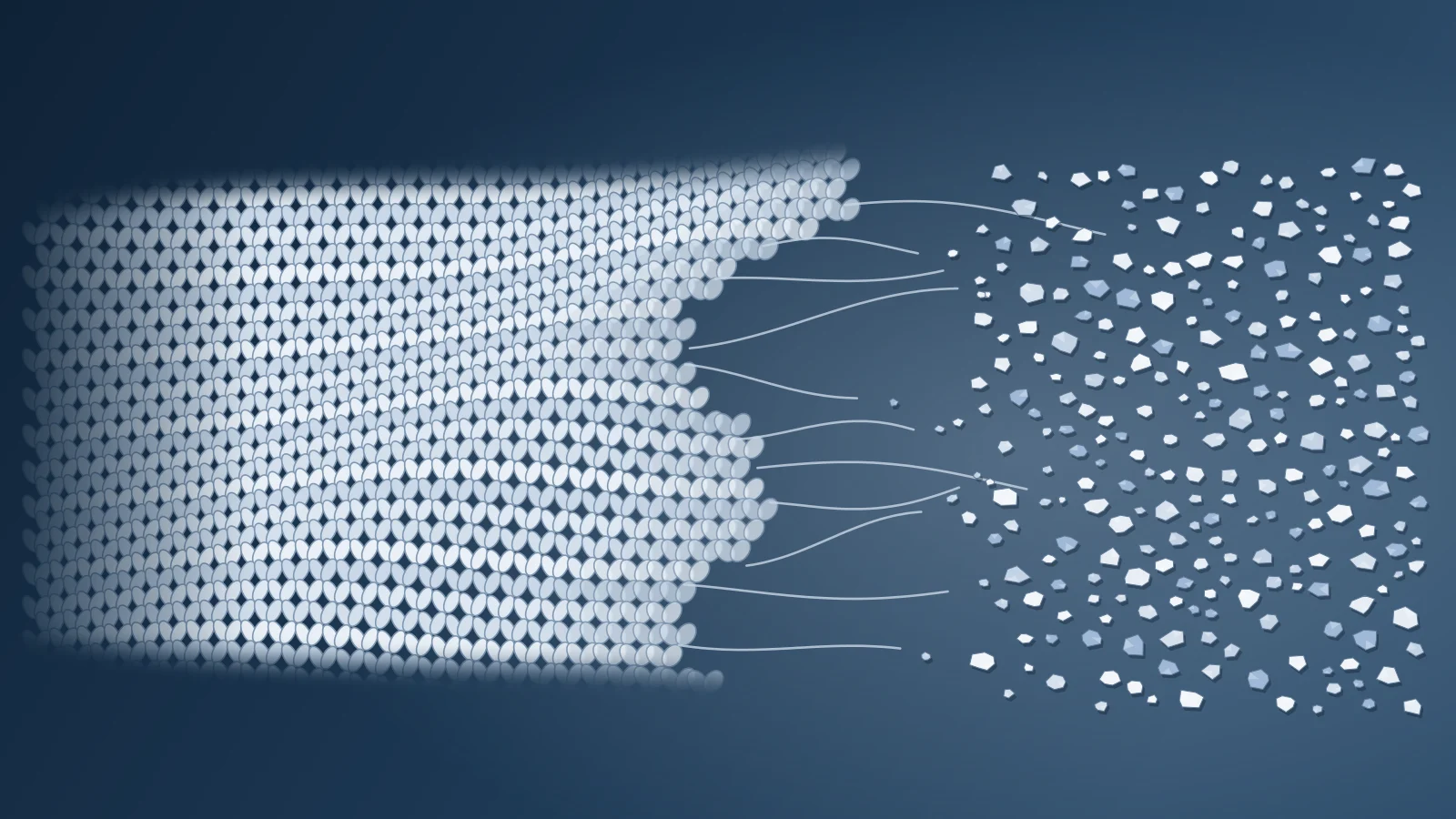
On 29 September 2026, the French company Carbios announced that recycled polyester T-shirts had been produced on European industrial manufacturing lines from "complex textile and plastic waste", in a consortium with Patagonia, PUMA and Salomon (Carbios, 29 September 2026). The polyester came from Carbios's enzymatic process, which breaks poly(ethylene terephthalate) (PET) back into its two monomers so that new polymer can be made from them. Five days earlier, the same company reported that financing for its first commercial plant, at Longlaville in north-eastern France, had still not closed (Carbios, 24 September 2026).
Both statements can be true at once, because they answer different questions. A product validation shows that a material can pass through a manufacturing chain and meet the specifications of the people who buy it. Commercial production asks whether a plant can do that continuously, at design capacity, on the feedstock it can actually buy, at a cost someone will pay. This article sets out what the September validation demonstrated, explains the chemistry and process engineering behind each step, and identifies the evidence that would still be needed to call enzymatic PET recycling a stable industrial process.
Status as of 6 October 2026. This article reviews published evidence on one technology and one company's disclosures. Where it says that Carbios has not published or disclosed something, that refers to the Carbios releases and reports listed under References, as read up to that date. It is not a survey of all recycling projects and not an investment assessment.
What the September Validation Showed
The release describes the chain step by step and names who did most of it. Carbios says its process turned the waste into monomers "that meet stringent quality and performance standards, comparable to those of petrochemical-derived materials". The Portuguese polymer producer Selenis repolymerised those monomers into "more than one ton" of recycled PET (r-PET), sold as EnzyTex. Four named companies in Spain and France then spun, knitted, dyed and sewed it, "with each step carried out under standard industrial conditions". The French text of the release, which Carbios designates as its official version, matches the English on these points.
| Step | Who carried it out | Scale as disclosed | Type of evidence |
|---|---|---|---|
| Feedstock | Not applicable | Complex textile waste (pre-industrial and post-consumer textiles) and complex plastic waste; proportions and batching not disclosed | Company release |
| Pretreatment and enzymatic depolymerisation | Carbios | "Pre-industrial recycling"; site of this batch not stated | Company release |
| Monomer purification | Carbios | Not stated separately | Company release |
| Repolymerisation to r-PET | Selenis, Portugal | "More than one ton" | Company release |
| Spinning | ANTEX, Spain | Industrial production lines | Company release |
| Knitting (interlock fabric) and dyeing | Henitex and TAD, France | Industrial equipment, industrial dye bath | Company release |
| Garment making | ToptexCube (Chamatex Group), France | Not stated | Company release |
Table 1. The production chain described in Carbios's release of 29 September 2026. "Company release" means the statement is Carbios's own; no independent test report was published with it.
The release itself distinguishes two scales. Its summary describes "full validation across the textile value chain, from pre-industrial recycling to industrial-scale manufacturing". Industrial scale applies to the downstream steps: polymerisation, spinning, knitting, dyeing and sewing. The recycling step is described as pre-industrial. Neither the English nor the French release says where the depolymerisation for this batch took place, and none of the other Carbios documents reviewed for this article says so either (the releases of 21 July and 24 September 2026, the 2025 Universal Registration Document and the 2026 half-year report). For context, Carbios reported in July that it had completed 100 batches since commissioning its demonstration plant in Clermont-Ferrand, including campaigns on complex post-consumer textile waste (Carbios, 21 July 2026). Whether the September monomers came from those campaigns is not stated.
The release names several kinds of waste but not how they were combined. It lists complex textile waste, both pre-industrial and post-consumer, and complex plastic waste, and explains that the materials are "considered difficult to recycle due to fiber blends (cotton, elastane) and contaminants (dyes, finishes, silicones)". It gives no split between textile and plastic waste, does not say whether the categories were processed together or in separate batches, and gives no batch count and no figure for how much of the incoming waste ended up as r-PET. It does not say what happened to the cotton, elastane, dyes and finishes.
The performance claim is the company's. According to the release, the fibres showed "full compatibility with conventional textile manufacturing processes" and mechanical strength, dyeability and colour fastness "equivalent to those of virgin polyester". The release does not name the testing laboratory, the test methods or the results. A brand partner, PUMA, is quoted as saying that "complex PET waste can be recycled into high-quality polyester fibers under existing industrial conditions".
What this establishes. On the company's account, r-PET made from enzymatically recovered monomers ran through ordinary industrial textile lines without special handling and produced a garment. That matters, because a recycled polymer that needs special handling at each converter has limited value however it was made. What the release does not establish is continuous operation of the recycling step, operation at commercial scale, the yield from waste to polymer, or cost.
How an Enzyme Cuts PET, and Why Crystallinity Is the Gate
The reaction is hydrolysis of an ester bond. PET is a polyester of terephthalic acid (TPA) and ethylene glycol (EG). A PET hydrolase adds water across the ester links and releases TPA and EG, passing through short intermediates. The step runs in water at moderate temperature: Carbios describes its process as depolymerisation "in an aqueous medium at low temperature (approx. 65°C)" after pretreatment such as extrusion and size reduction (Carbios 2025 Universal Registration Document, p. 19).
The benchmark enzyme came from protein engineering. In 2020, researchers from Carbios and laboratories in Toulouse reported an engineered variant of leaf-branch compost cutinase, LCC-ICCG, that depolymerised at least 90% of PET into monomers within 10 hours at 200 g of PET per kilogram of reaction mixture and 3 mg of enzyme per gram of PET. They also made bottles from the recycled monomers (Tournier et al., Nature, 2020). LCC-ICCG remains a standard reference enzyme in the academic studies cited below.
Crystalline PET resists the enzyme. PET chains packed into crystallites lack the mobility the enzyme needs to hydrolyse them efficiently, so semicrystalline PET is first melted and cooled quickly into a mostly amorphous state (Garate et al., PNAS, 2025). Researchers at the US National Renewable Energy Laboratory (NREL) note that most PET hydrolases need substrate crystallinity "typically <15%" and pH control near neutral (Murphy et al., Nature Chemical Engineering, 2025). The reaction temperature is a compromise. The amorphous chains must be mobile enough to be attacked, which favours operating above PET's glass transition, but the same mobility lets the polymer recrystallise, which slows and can eventually stop the hydrolysis. PET is workable because it crystallises slowly near that window (Garate et al.).
How the amorphisation is done changes the economics. Murphy et al. compared two routes in the laboratory. Cryomilled powder (about 10% crystalline) was fully depolymerised in about 10 hours. Pellets made by extruding recycled bottle flake into a chilled water bath (also about 10% crystalline) took about 50 hours to reach complete conversion under the same conditions. In their process model, the slower pellets still came out ahead, because cryomilling needs liquid nitrogen and an air-separation unit. The modelled pelletisation route had 60% lower installed cost and 30% lower operating cost for that step.
In the reactor processes studied, high conversion depends on making PET largely amorphous before the reaction and limiting its recrystallisation during it.
The scope is narrow, and deliberately so. This is a controlled reactor process for pretreated PET, at around 65 °C, with engineered enzymes and pH control. It says nothing about how PET behaves in soil, water or landfill, where none of these conditions exists. It also does not carry over automatically to other polyesters. In the PNAS study, fully crystalline poly(butylene terephthalate) (PBT), which cannot be amorphised by ice-water quenching, gave a depolymerisation yield below 1% after 24 hours with LCC-ICCG.
Why Textile Waste Is Not Bottle Flake
Fibre PET is formulated differently from bottle PET. Bottles are made of high-molecular-weight PET with few additives and are easy to sort. Many fibres and fabrics contain short polymer chains or nucleating agents that deliberately speed up crystallisation, and dyes, pigments and other polymers can do the same (Garate et al.). The PNAS group measured the difference directly. Bottle flake fell from 30% to 10% crystallinity after melt quenching, and a PET swimwear lining fell from 39% to 15%. After 24 hours with LCC-ICCG at 65 °C, the amorphised bottle flake reached 94% depolymerisation and the textile 83%; bottle flake that had not been amorphised reached 52%.
Blends and process scrap are harder still. A sportswear fabric made of mixed PET and PBT fibres reached only 13% depolymerisation after amorphisation, because the PBT recrystallised at reaction temperature and dragged the PET with it. A non-woven PET automotive scrap reached 36% in one batch, and less in others (Garate et al.). The authors' own remedy, reactive melt blending to make slowly crystallising copolyesters, raised some of these yields to about 90% in the laboratory. It is one research route, not an established industrial step. Protein Evolution Inc. supported the study; some coauthors were affiliated with or had consulted for the company, and several were named on related patent applications.
Non-PET fibres have to go somewhere. Laboratory studies have taken blended textiles apart step by step with different agents:
- Sequential enzymes. A protease and then a cellulase were used to recover the building blocks of the wool and cellulose fibres in model blends and in a real textile waste sample. How much was recovered depended on the fibre component and the sample, and cellulose recovery fell in model blends with more PET. The PET left behind was assessed separately, by infrared spectroscopy; those recovery figures are not a measure of PET recovery (Quartinello et al., Polymers, 2018).
- Enzyme then solvent. After enzymatic wool removal from a wool/PET/elastane fabric, elastane was dissolved in dimethyl sulfoxide (DMSO) at 120 °C in 10 minutes, leaving intact PET fibres (Boschmeier et al., Waste Management & Research, 2025). The largest batch reported was 200 g of textile in a 4-litre vessel.
- Cellulase then PET hydrolase. In polyester–cotton blends of 65/35, 70/30 and 80/20, cotton was hydrolysed first and the PET then depolymerised by an engineered hydrolase. The abstract reports monomer recovery of 90–92% and TPA purity above 99% by NMR (Wang et al., Chinese Journal of Biotechnology, 2025; abstract only reviewed).
These are separate laboratory demonstrations on different fabrics. None of them describes what Carbios does with cotton, elastane or finishes, which the company has not disclosed in the documents reviewed.
The incumbent route for recycled polyester fibre starts from bottles. Textile Exchange, an industry association, estimates that about 9.7 million tonnes of recycled polyester were produced in 2025 and that about 97% of it came from plastic bottles (Textile Exchange, Materials Market Report 2026). That figure describes the origin of the feedstock, not the recycling technology used, and the remaining few per cent are not all textile-to-textile. Clean bottles have advantages that textile waste lacks: uniform polymer, few additives and established collection. The NREL authors write that clean, high-quality PET "can and should be mechanically recycled due to the inherent energetic advantages of that approach", and they see depolymerisation as a route for the streams that mechanical recycling handles poorly, such as thermoforms, coloured bottles, textiles and fines.
From Hydrolysate to Polymer-Grade Monomer
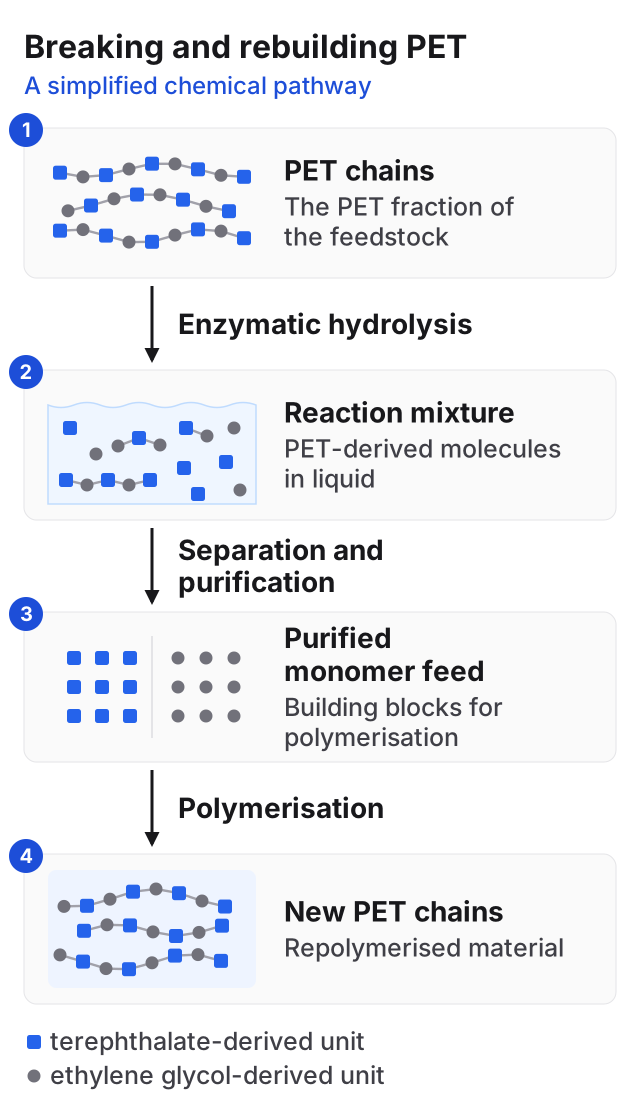
The enzyme step leaves a dilute aqueous liquor that still has to be cleaned up. Turning it into monomers clean enough for polymerisation is a separations problem, and the NREL process study discussed below puts much of the cost and environmental burden of its modelled design here rather than in the enzyme. Carbios lists its downstream operations as "filtration, decoloration, purification, AT [terephthalic acid] crystallization, MEG distillation" (Universal Registration Document, p. 19). The documents reviewed do not give the chemistry or the consumption figures for these steps.
In the NREL designs, pH control creates a salt problem. Each TPA released is a diacid, so the reaction acidifies as it proceeds, while most PET hydrolases need near-neutral pH. In the process Murphy et al. tested and modelled, base is added continuously, and TPA ends up as a dissolved or precipitated salt. In their conventional design, sodium hydroxide holds the pH and sulfuric acid later converts the disodium salt back to TPA. That generates 0.85 kg of sodium sulfate for every kilogram of TPA (Murphy et al.). The NREL team tested ammonium hydroxide instead. In 0.25-litre bioreactor runs, the ammonium terephthalate salt precipitated and could be split back into TPA and ammonia by heating to about 190 °C, so the ammonia can be recycled. In their model, this cut acid and base consumption by more than 99% and the annual operating cost of those unit operations by 74%. Average TPA yields in the five-pass reactor experiments were 87.8% with sodium hydroxide and 91.1% with ammonium hydroxide. These are the study's choices and results; the documents reviewed do not say how Carbios controls pH or recovers TPA.
Ethylene glycol has to be pulled out of water. EG leaves the reactor as a dilute aqueous solution, and distilling off the water is energy-intensive. In NREL's earlier reference design, EG recovery accounted for 88% of steam use. The team found that LCC-ICCG lost no significant activity over 24 hours until EG concentrations exceeded 250 g/L. That allowed a fed-batch scheme in which fresh PET and enzyme are added to the same liquor several times, raising the EG concentration before distillation. Experimentally, the liquor reached no more than 70 g/L because of equipment constraints; the process model assumed 250 g/L. More detail on the glycol itself is on ChemAbout's ethylene glycol compound page.
In NREL's packaging-bale model, the enzyme was a small share of the cost; pretreatment and the separations around the enzyme were material cost centres.
The headline metrics measure different things. Announcements of recycling performance often report one of the metrics below and leave the others out.
| Metric | What it measures | Example values (owner, date) |
|---|---|---|
| Conversion | Share of the PET in the reactor that has been depolymerised | "More than 95% conversion achieved within 24 hours on complex post-consumer textile waste streams" (Carbios, 21 July 2026; no data published); at least 90% in 10 h (Tournier et al., 2020) |
| Monomer yield | TPA (or EG) actually recovered as a share of the theoretical amount | 87.8% and 91.1% average TPA yield in five-pass bioreactor runs (Murphy et al., 2025, cryomilled amorphous PET) |
| Purity | Share of the recovered product that is the target monomer | Residual PET and oligomers 2.9% of recovered ammonium terephthalate solids before recrystallisation (Murphy et al., 2025); TPA >99% by NMR (Wang et al., 2025, abstract) |
| Recycled content | Share of recycled input in the final product | "100% recycled polyester products" (Carbios, 29 September 2026); the NREL model sets recycled content at 98% because make-up EG from petrochemical sources is used in polymerisation |
| Whole-process mass yield | Product out per tonne of waste in | 0.92 kg of r-PET per kg of bale, modelled (Murphy et al., 2025); not disclosed for the September validation |
Table 2. Five metrics that are often confused. A high value for one says little about the others.
A product can be 100% recycled polyester while a substantial share of the incoming waste leaves the process as something else. Conversion can be high while yield after purification is lower. Purity is meaningful only against a specification, and the Carbios documents reviewed give none for the September r-PET.
What a Process Model Can Answer
The most detailed public model is for packaging waste, not textiles. Murphy et al., a peer-reviewed study from NREL, the University of Massachusetts Lowell and the University of Portsmouth published in May 2025, combined laboratory data with process simulation and techno-economic and life-cycle analysis. Several authors have filed provisional US patent applications on the glycol and terephthalate-salt recovery the paper describes, and one author is a member of the advisory board of Samsara Eco, as the paper discloses. The study is process research. It is not an audit of any company, and it does not model Carbios's process.
What was modelled. A plant processing 150 tonnes per day (about 55,000 tonnes per year) of post-consumer thermoform and coloured PET bales, bought at $0.40/kg with 5% impurities. The process steps were melt extrusion and pelletising, depolymerisation at 20 wt% solids and 65 °C with 24 hours per pass (faster than the roughly 50 hours measured for pellets; at 72 hours the modelled price rises by only about 4%), five passes on the same liquor, ammonium hydroxide pH control, and EG distillation with mechanical vapour recompression. Costs are on a 2022 basis with a 30-year plant life and a 12% after-tax internal rate of return (Supplementary Information, Table 8).
What it found, within those boundaries. The modelled minimum selling price (MSP) of the recycled PET, the price at which the plant's net present value is zero, was $1.51/kg. The paper compares this with an average US market price for bottle-grade PET of $1.87/kg over 2018–2022. Its cost figure also shows a five-year average for bottle-grade PET in north-east Asia of $1.15/kg, which is below the modelled MSP. The largest contributors to the MSP were capital recovery (34%) and feedstock (30%). Waste treatment contributed 9%, enzyme about 4% and electricity about 5%.
The feedstock price moves the answer most. When the authors' sensitivity analysis raised the feedstock price from $0.40/kg to $1.00/kg, a figure they give as the estimated price for "manually sorted, detrimmed textiles", the modelled MSP rose from $1.51/kg to about $2.20/kg (Supplementary Table 23). Only the price changed in that scenario. The process, yields and impurities remained those of the packaging-bale design, so it is not a model of blended textile waste. A smaller plant (50 tonnes per day) gave $1.98/kg.
The environmental result has a stated boundary. On a cradle-to-gate basis, from collection of post-consumer PET to r-PET pellet, the modelled process emitted 46% less greenhouse gas than virgin PET production, and 62% less with decarbonised electricity and heat. It scored worse than virgin PET on human toxicity and land use, mainly through waste treatment, feedstock collection and enzyme production. The authors conclude that "waste generation remains the primary challenge", noting about 3 wt% EG in the wastewater stream.
What the model cannot answer. It cannot give the cost of a textile-fed plant, the yield from real mixed textile waste, the reliability of a plant over years, or any company's margins. It shows which variables decide the outcome: feedstock price and quality, capital intensity, solids loading, plant size, and the separations around the enzyme.
The Evidence Still Needed for Commercial Production
Where Carbios's own plants stand. Construction of the Longlaville plant, sized at around 50,000 tonnes of PET waste per year, began in October 2023 and was suspended in December 2024 (Universal Registration Document, p. 24). On 3 August 2026, Carbios said that ongoing due diligence would not allow it to meet its target of financial close by 30 September 2026, and that this "postpones the expected timeline for the start of production". The previous target had been the first half of 2028 (Carbios, 3 August 2026). None of the Carbios documents reviewed gives a new start date. The half-year report published in September says that the plant's financing has yet to be secured and estimates the plant's construction cost at €230 million (Carbios 2026 half-year report, pp. 6 and 19, in French). Carbios reports credit-committee approval from a majority of lenders, continuing due diligence by export credit agencies and equity partners, €42.5 million of secured public grants, and a beverage-industry agreement being finalised that it expects to raise pre-sales to 60% of nominal capacity. It also says that independent reviews of the project's technical, economic, environmental and legal aspects "confirm both its economic viability and the relevance of its location in France". The underlying reports were not included in, or linked from, the Carbios materials reviewed for this article. Separately, Carbios expects the first plant licensed to its Chinese partner Wankai, in Haining, to be commissioned by the first half of 2028 (Carbios, 2 June 2026).
These are financing and construction facts about one company's projects. Late financing is not evidence of a technical failure, and lender approvals or brand partnerships are not evidence of cost competitiveness. This article has not surveyed other companies' enzymatic or chemical depolymerisation plants.
Seven kinds of evidence would close the gap. Each is something a demonstration batch or a product validation cannot supply.
- A mass balance for textile feedstock. Tonnes of waste in, tonnes of r-PET out, and the destination and quantity of every non-PET stream: cotton, elastane, dyes, finishes and residues.
- Published specifications with methods. Monomer and polymer specifications, and garment test results with named methods, so that "equivalent to virgin" can be checked.
- Continuous operation data. Time on stream, batch-to-batch consistency, enzyme consumption per tonne and how often purification units foul or need cleaning, over months rather than campaigns.
- Feedstock at volume. Textile waste has to be collected, sorted by composition and stripped of zips, buttons and prints before it reaches a reactor. Carbios's own risk disclosures identify supply-chain build-up as a risk even for packaging feedstock (Universal Registration Document, p. 51).
- Effluent and by-products. The volume and treatment of wastewater, and the fate of salts and residual glycol, which the NREL model identifies as the main remaining environmental burden.
- Plant-level cost on real feedstock prices. Measured costs from a running plant, rather than modelled ones from a design for a different feedstock.
- A life-cycle assessment for textile feedstock. Done with a stated boundary and a stated comparison product, since the published model covers packaging bales.
A recycled T-shirt shows that the material works in a textile mill. Assessing commercial performance calls for evidence of sustained operation, consistent product quality and process economics under representative operating conditions.
The September validation answered a real question that earlier work had left open, and it answered it on industrial textile equipment. The questions that remain concern the recycling step itself at scale, and the Carbios documents reviewed here do not publish the plant-operation data that would answer them.
References and Further Reading
Company disclosures (Carbios)
- Carbios, Carbios and the Fiber-to-Fiber Consortium successfully validate the industrial-scale production of recycled polyester T-shirts made from complex plastic and textile waste, 29 September 2026
- Carbios, Carbios reports first-half 2026 results, 24 September 2026
- Carbios, Rapport financier semestriel 2026 (half-year financial report, in French)
- Carbios, Carbios provides an update on the financing of its Longlaville plant project, 3 August 2026
- Carbios, Carbios reaches milestone of 100 batches at its Industrial demonstration plant and expands its licensing offering to the textile market, 21 July 2026
- Carbios, Update on the Carbios – Wankai project in China, 2 June 2026
- Carbios, 2025 Universal Registration Document
Research
- Murphy NP, Dempsey SH, DesVeaux JS et al. Process innovations to enable viable enzymatic poly(ethylene terephthalate) recycling. Nat Chem Eng 2025;2:309–320 (accepted manuscript, OSTI)
- Tournier V, Topham CM, Gilles A et al. An engineered PET depolymerase to break down and recycle plastic bottles. Nature 2020;580:216–219
- Garate H, Freymond C, Breloy L et al. Reactive mixing enables enzymatic depolymerization of recalcitrant or unsortable polyester wastes. Proc Natl Acad Sci USA 2025;122
- Quartinello F, Vecchiato S, Weinberger S et al. Highly selective enzymatic recovery of building blocks from wool-cotton-polyester textile waste blends. Polymers 2018;10:1107
- Boschmeier E, Mehanni D, Sedlmayr VL et al. Recovery of pure PET from wool/PET/elastane textile waste through step-wise enzymatic and chemical processing. Waste Manag Res 2025
- Wang H, Cun Y, Wang M et al. Enzymatic depolymerization of polyester-cotton textiles for the recovery of terephthalic acid. Sheng Wu Gong Cheng Xue Bao (Chin J Biotechnol) 2025
Industry data