Back to insights
Article/ Compliance
PFAS Regulation Enters a New Phase: What 2026 Changes for the Chemical Industry
23 min read

From 10 October 2026, a REACH restriction on undecafluorohexanoic acid (PFHxA) begins to apply to a specified set of products: textiles, leather, furs and hides in clothing and related accessories for the general public; footwear for the general public; paper and cardboard food-contact materials; mixtures for the general public; and cosmetics. In those categories, PFHxA may not be placed on the market or used at or above 25 ppb for the sum of PFHxA and its salts, or 1,000 ppb for the sum of PFHxA-related substances, measured in homogeneous material (Commission Regulation (EU) 2024/2462, Annex XVII entry 79). Certain protective equipment, medical devices and construction textiles are exempt, products placed on the market before the date are not affected, and other consumer textiles follow in October 2027.
The date matters because of what PFHxA is. It can be a persistent transformation product of the C6 fluorotelomer chemistry that industry adopted as PFOA and other long-chain substances came under restriction. In 2026, European regulation reaches the substitute.
The same year shows a larger shift. A restriction covering all PFAS in firefighting foams has been in force since October 2025. PFAS limits for food-contact packaging have applied since August. ECHA's scientific committees are completing their assessment of a proposal to restrict PFAS as a class across most uses. No final universal PFAS restriction has been adopted, and no application date has been established.
The direction is nonetheless clear: European PFAS regulation is moving from controls on individual substances and narrow groups toward broader class-level management. Drafting such a restriction is not the hard part. Replacing what fluorinated chemistry does is, and that depends far more on the application than on the molecule.
2026: The Year the Regulatory Architecture Became Visible
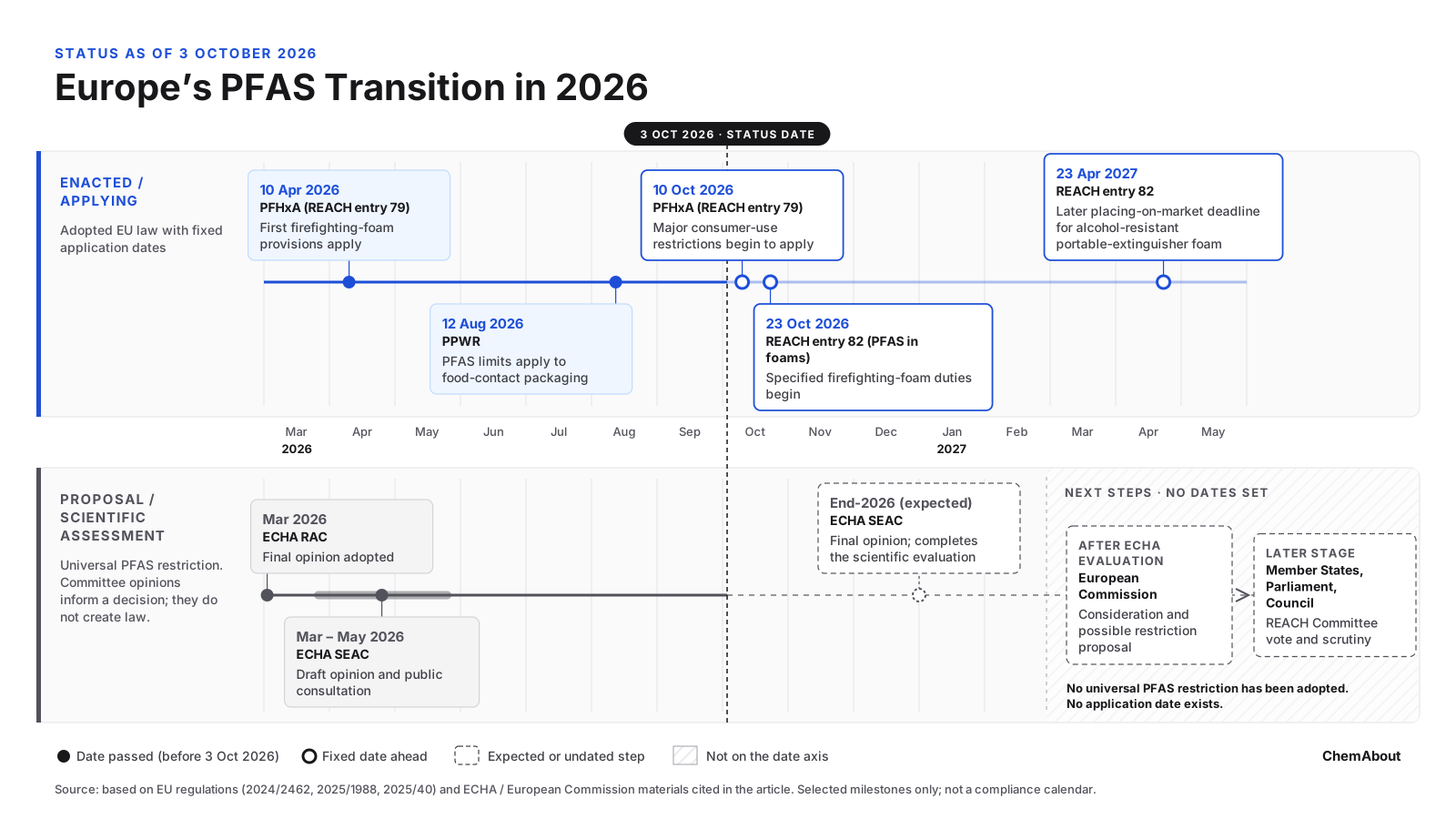
The 2026 milestones belong to two different tracks. Some are enacted law with fixed dates. Others are scientific assessment, which informs a future decision but binds no one.
| Date | Development | Track |
|---|---|---|
| 2 March | ECHA's Committee for Risk Assessment (RAC) adopts its final opinion on the universal PFAS restriction proposal | Scientific assessment |
| 10 March; consultation 26 March – 25 May | Committee for Socio-Economic Analysis (SEAC) agrees its draft opinion and consults on it | Scientific assessment |
| 10 April | PFHxA (entry 79): limits apply to firefighting foams for training and testing and for public fire services, with stated exceptions | Enacted, applying |
| 12 August | PPWR: PFAS limits for food-contact packaging apply | Enacted, applying |
| 10 October | PFHxA (entry 79): limits apply to the consumer categories listed above | Enacted, applies from this date |
| 23 October | All-PFAS foam restriction (entry 82): placing PFAS-containing foam on the market in portable extinguishers ends (alcohol-resistant foam: 23 April 2027); labelling and conditions of use begin | Enacted, dates ahead |
| By end-2026 (expected) | SEAC final opinion, completing ECHA's scientific assessment | Scientific assessment |
Status as of 3 October 2026. Sources: Regulation (EU) 2024/2462; Regulation (EU) 2025/40, Art. 5(5); Regulation (EU) 2025/1988; ECHA Weekly, 4 March 2026; ECHA.
The two foam instruments need to be kept apart. The April 2026 foam dates belong to the PFHxA restriction. The separate entry 82, added by Regulation (EU) 2025/1988, restricts firefighting foams containing PFAS at or above 1 mg/L for the sum of all PFAS. Its general deadline for placing on the market and use is 23 October 2030. It separates market dates from use dates: PFAS-containing foams in portable extinguishers may no longer be placed on the market after 23 October 2026 (alcohol-resistant foams: 23 April 2027), but may still be used until 31 December 2030. Seveso establishments (excluding civil aviation), offshore oil and gas installations, military vessels, and civilian ships whose foam was already on board before 23 October 2025 have until 23 October 2035. From 23 October 2026, users relying on those long transitions will have to restrict foam use to flammable-liquid fires, minimise emissions, collect PFAS-containing waste and keep a site management plan.
The PPWR rule is likewise narrower than headlines suggest. It covers food-contact packaging, not all packaging (Regulation (EU) 2025/40, Art. 5(5); European Commission, 11 August 2026).
The universal restriction follows a longer path. Five national authorities submitted a restriction dossier in 2023. RAC and SEAC assess it scientifically. The Commission then considers whether and how to propose an amendment to REACH Annex XVII. Member States vote in the REACH Committee, under scrutiny by the European Parliament and Council. Only after that could a final restriction be adopted. The committees' opinions inform that process; they do not create law. RAC's final opinion and SEAC's draft both support an EU-wide restriction subject to specific derogations (ECHA). The Commission has said that "once the European Chemicals Agency delivers its final scientific assessment by the end of 2026, the Commission will present a restriction proposal aimed at minimising PFAS emissions" (European Commission, 15 June 2026).
Why Regulating One Molecule at a Time Stopped Working
PFOS, PFOA and PFHxS were each listed under the Stockholm Convention only after years of substance-specific evaluation (Stockholm Convention Secretariat). Each time, industry could move to nearby structures that the listing did not cover.
The move from C8 to C6 chemistry shows the pattern. Fluorotelomer side-chain polymers, used to make textiles and paper repel water and grease, were redesigned around shorter perfluorinated chains. PFHxA can form as a persistent transformation product of relevant C6 fluorotelomer substances. The pathways and yields depend on precursor structure and environmental conditions. The PFHxA restriction states that the acid "by far exceeds the 'very persistent' criterion" of REACH and is mobile in water (recital 1). That is why it sets a separate, higher threshold for "PFHxA-related substances": those that, "based on their molecular structure, are considered to have the potential to degrade or be transformed to PFHxA". The precursors are targeted alongside the acid.
Certain short-chain perfluoroalkyl acids generally show lower bioaccumulation potential than longer-chain analogues in some organisms and compartments. They often also show high mobility in soil and water, extreme persistence, and resistance to conventional water treatment (Brendel et al., 2018). Shorter chains are therefore not simply safer. The change improved one property while leaving another unchanged. That is "regrettable substitution" in a precise sense: a substitute that keeps the property that made the original a problem.
The case for class-level management rests on that property. Cousins and co-authors note that PFAS are diverse in structure, bioaccumulation potential and toxicity, but share perfluoroalkyl moieties that resist environmental and metabolic degradation (Cousins et al., 2020). Some PFAS are themselves highly persistent. Others are precursors that transform into persistent terminal products, which are still PFAS. The concern this raises is about stock and reversibility, not toxicity as such. Continued release of very persistent substances means rising environmental concentrations, and any effect discovered later is slow and costly to reverse. In ECHA's March 2026 podcast on the committee opinions, RAC chair Roberto Scazzola put it simply: "Once the PFAS reach into the environment, they stay there for a very, very long time" (ECHA Safer Chemicals Podcast, 22 March 2026).
The fluoropolymer question
Fluoropolymers such as PTFE, fluoroelastomers and perfluorinated ionomers fall within the structural PFAS definition used in the universal proposal (Wang et al., 2021). They are where the class argument is most contested, and the debate becomes clearer when its parts are separated:
- The polymer itself. High-molecular-weight fluoropolymers are solids of very low solubility. Industry-authored reviews argue that commercial fluoroplastics and fluoroelastomers meet established criteria for "polymers of low concern" and should not be grouped with other PFAS for hazard assessment (Korzeniowski et al., 2023).
- Manufacturing aids and life-cycle emissions. Other researchers point to fluorinated polymerisation aids used in production, and to monomers, oligomers and other PFAS emitted during manufacture and processing. They conclude there is no scientific basis for treating fluoropolymers as of low concern (Lohmann et al., 2020).
- End of life. Recycling options for consumer articles are limited, and emissions depend on whether waste is landfilled or incinerated (Lohmann et al., 2020).
- Regulatory treatment. ECHA's summary of the March 2026 podcast says the committees found limited evidence of bioaccumulation for the polymers themselves, but concerning PFAS emissions from production and disposal. How fluoropolymers are treated in any final restriction remains open.
What Fluorinated Chemistry Actually Supplies
Fluorine is the most electronegative element. Bonded to carbon, it forms among the strongest single bonds in organic chemistry, and it is a weak coordinator (O'Hagan, 2008). But the performance of a fluorinated material does not follow from the C–F bond alone. It comes from a combination of factors:
- the C–F bond chemistry;
- molecular architecture, such as chain length, branching and terminal –CF₃ groups;
- functional groups, such as the sulfonic acid of an ionomer or the sulfonate anion of a photoacid generator;
- polymer morphology and crystallinity, such as highly crystalline PTFE compared with cross-linked fluoroelastomers;
- which groups actually sit at the outermost surface;
- processing and microstructure.
The tightly held electrons of perfluorinated segments contribute to weak intermolecular interactions. Where such segments dominate a surface, this gives low surface energy; Nishino and co-workers reported an exceptionally low value for a close-packed, aligned –CF₃ surface (Nishino et al., 1999). Other properties are material-specific rather than general. PTFE is valued for low dielectric constant and loss. Polyvinylidene fluoride (PVDF), by contrast, is strongly polar and is used for its piezoelectric behaviour and its stability as a battery binder.
Persistence follows from the same combination. A perfluorinated segment has strong bonds, no carbon–hydrogen bonds for oxidants or enzymes to attack, and a fluorine-rich exterior shielding the carbon backbone.
Why "repellency" is several properties
Wetting is where substitution is most often misdescribed. On conventional smooth surfaces, lower solid surface energy generally means higher contact angles. Actual behaviour also depends on the solid–liquid interfacial energy, on roughness and texture, on the wetting state (whether liquid fills a texture or sits on trapped air), and on contact-angle hysteresis. Practical requirements therefore split into distinct properties:
- Non-wetting: a high static contact angle.
- Low adhesion and droplet mobility: low hysteresis, so drops roll or slide off.
- Grease-barrier performance: resisting penetration of oil into a porous substrate over time and temperature. This is a transport problem, not just a contact angle.
Repelling water is achievable with hydrocarbon and silicone chemistry. Repelling low-surface-tension oils on a practical, durable surface has historically relied on fluorinated groups at the surface, and that is where much of the substitution difficulty sits.
There Is No Single "PFAS Replacement"
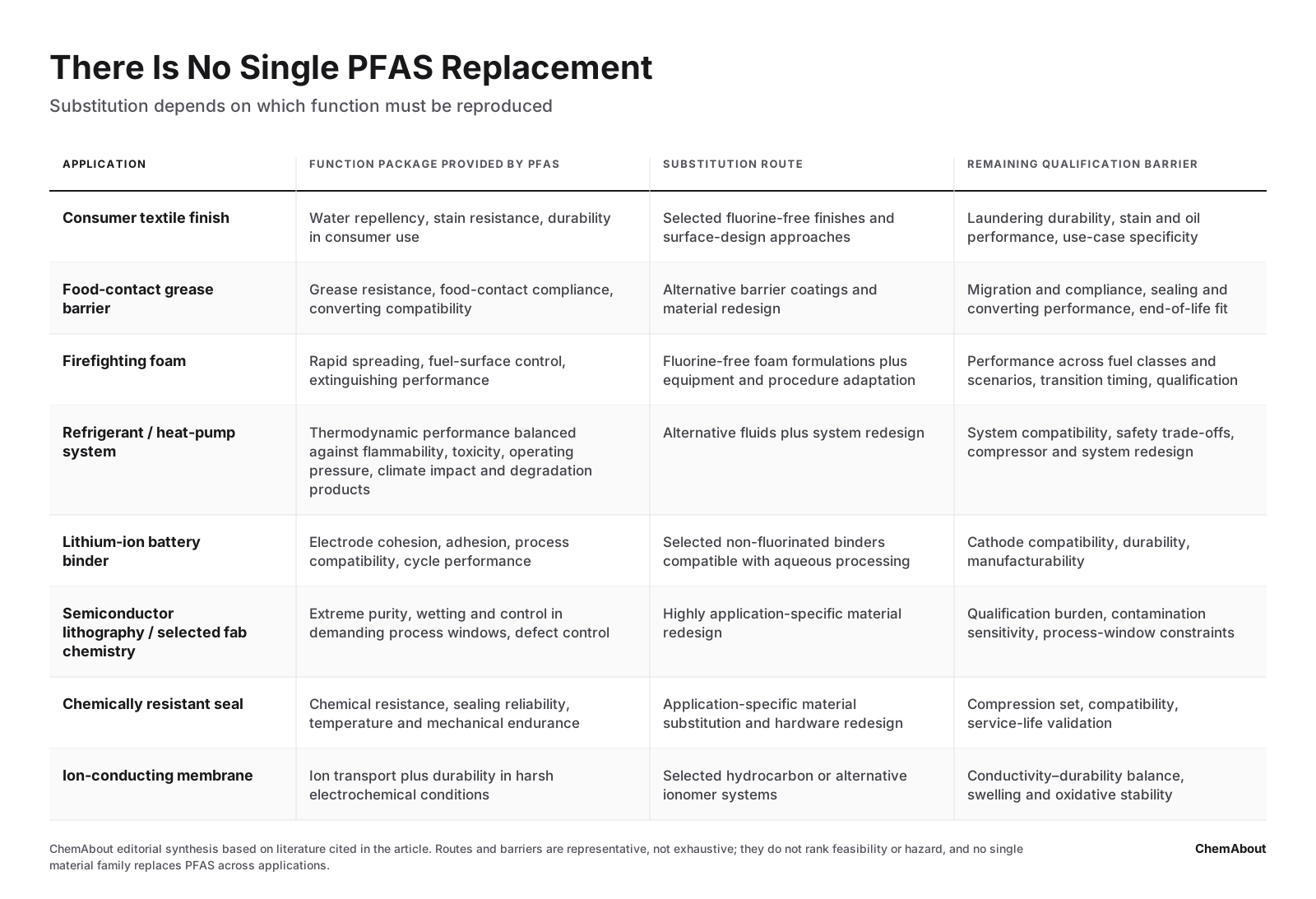
PFAS appear in more than 200 use categories and subcategories, often for different functions (Glüge et al., 2020). Substitution therefore has to start from the function, not the chemical class.
| Application | Function package provided by PFAS | Substitution route | Remaining qualification barrier |
|---|---|---|---|
| Consumer textile finish | Water repellency and, where specified, oil and stain repellency that survives wear | Non-fluorinated water-repellent finishes; relaxing the oil-repellency requirement | Durability after laundering and abrasion; weaker repellency toward low-surface-tension liquids |
| Food-contact grease barrier | Resistance to oil and grease penetration in paper and board, including hot, fatty foods | Densified fibre, aqueous barrier coatings, laminated structures | Barrier over time and temperature; migration; folding, sealing and converting; recyclability |
| Firefighting foam | Fast knockdown and burnback resistance on flammable-liquid fires | Fluorine-free foam formulations; adapted equipment and tactics | Extinguishing performance across fuels and fire scales; residual PFAS in equipment; approvals |
| Refrigerant / heat-pump system | A balance of thermodynamic performance, flammability, toxicity, operating pressure, climate impact and degradation products, which varies by refrigerant | Propane, isobutane, CO₂ or ammonia in redesigned systems | Flammability and charge limits; high pressure; toxicity; compressor and safety-code redesign |
| Lithium-ion battery binder | Electrode cohesion and adhesion, electrochemical stability at cathode potentials, fit with existing slurry processing | Non-fluorinated binders compatible with aqueous processing | Adhesion and cycle life; cathode stability in water; current-collector corrosion; line compatibility |
| Semiconductor lithography and selected fab chemistry | Strong, controllably diffusing photogenerated acid; surfactancy in aggressive baths; clean fluid handling | Non-fluorinated candidates for selected functions | Defectivity, contamination and requalification of the process window at each node |
| Chemically resistant seal | Sealing force retained in aggressive media at temperature | Non-fluorinated elastomers or polymers selected per medium; metal seals; equipment redesign | Compatibility with each medium; compression set; temperature range; purity in high-purity service |
| Ion-conducting membrane | Proton conduction with oxidative and chemical durability | Hydrocarbon ionomer membranes | Conductivity at operating humidity; swelling; oxidative durability over service life |
ChemAbout editorial synthesis based on the literature cited in this article. Routes and barriers are representative, not exhaustive, and do not rank feasibility for any specific product.
The evidence varies by row:
- Textiles. The best non-fluorinated water repellents matched short-chain fluorinated finishes on water repellency, but repellency toward low-surface-tension liquids was clearly reduced (Schellenberger et al., 2019). The PFHxA restriction gave non-clothing consumer textiles a longer transition because of "functional losses where alternatives do not provide sufficient oil and stain repellence" (recital 17).
- Foams. SEAC concluded that fluorine-free foams are available and can be implemented "in most but not all sectors or uses by the end of the transitional periods proposed by the Agency". That is why the longest transitions went to Seveso sites and offshore installations (Regulation (EU) 2025/1988, recitals).
- Refrigerants. HFO-1234yf, the low-GWP fluid that replaced HFC-134a in car air conditioning, falls within the structural PFAS definition. It degrades in the atmosphere almost entirely to trifluoroacetic acid, compared with up to about 30% for HFC-134a (David et al., 2021).
- Batteries. Water-processable binders are established at graphite anodes. Moving cathodes to aqueous processing "is certainly more challenging", in part because of aluminium current-collector corrosion (Bresser et al., 2018). Replacing the binder addresses the binder only; other fluorinated components of a cell are separate questions.
- Lithography. A specialist review concluded that "in almost all cases fluorine-free alternatives are very unlikely to provide the essential properties present in PFAS systems" (Ober et al., 2022). The authors argue for essential use, so this is an informed industry-side position rather than a neutral survey.
Being fluorine-free does not make a substitute safer. Each alternative carries its own hazard profile and is judged on it.
Replacing a Molecule Versus Replacing a Performance Envelope
Difficulty depends less on which fluorinated molecule is removed than on what the application must achieve.
A consumer rain jacket's specification is set by its user, and survey evidence suggests users rank water repellency and durability first (Schellenberger et al., 2019). A finish that sheds rain but lets an oil stain soak in has changed the product without making it fail.
A seal in a hydrofluoric acid line, a chemically amplified photoresist and a PEM electrolyser membrane are different problems:
- Several properties are needed at once. A seal in aggressive service must resist the medium, stay elastic at temperature and not contaminate a high-purity stream, all for years. Materials meeting one or two of these requirements exist. Materials meeting all of them are rare.
- Failure is costly. Weaker repellency costs customer satisfaction. A seal failure in hazardous service means a release, a shutdown or an injury.
- Qualification is interlocked. A photoacid generator's acid strength and diffusion interact with the resin, developer, topcoat and exposure tool, so changing one means requalifying the process window. (ChemAbout has examined how advanced photoresist is built.)
- Some requirements are fixed by physics. Membrane durability under oxidative radical attack cannot be negotiated away.
A molecule can often be replaced. A performance envelope, meaning the full set of properties an application needs at once, is much harder to replace.
The useful question for any use is therefore not "is there a PFAS-free chemical?" but "which required properties actually depend on fluorine, and what else could change?" The "essential use" concept asks the same thing: whether a use is necessary for health, safety or the functioning of society, and whether functional alternatives exist (Cousins et al., 2019).
The Industrial Race Is Not for a Universal PFAS Substitute
The commercial opportunity lies in reproducing specific functions on other platforms. Six routes are distinguishable, each with a different mechanism and its own qualification burden.
1. Molecular substitution. This means replacing a fluorinated molecule with a non-fluorinated one performing the same role, as with candidate non-fluorinated photoacid generators. The function is generating a strong acid on exposure. The mechanism changes the anion chemistry, and with it the acid strength and diffusion. Resolution, defectivity and the process window still have to be qualified, which is where Ober and colleagues are most sceptical.
2. Polymer redesign. Hydrocarbon ionomers replace a perfluorinated backbone with sulfonated hydrocarbon structures to carry protons. Conductivity is attainable. Swelling and long-term oxidative durability in fuel cells and electrolysers are what remain to be proven.
3. Formulation redesign. Fluorine-free foams combine hydrocarbon surfactants with polymeric stabilisers. They extinguish by building a stable foam blanket rather than spreading an aqueous film across the fuel. Performance across fuel types and fire scales is what SEAC found not yet demonstrated everywhere.
4. Surface engineering. This route targets oleophobicity, fluorine's hardest property, using geometry or molecular mobility instead of fluorinated chemistry. Doubly re-entrant microstructures made of silica have been shown to repel even liquids that wet almost everything, by trapping air beneath the liquid (Liu and Kim, 2014). Covalently attached, flexible silicone chains form "liquid-like" layers on which oil droplets slide because hysteresis is very low, not because surface energy is (Wang and McCarthy, 2016). Neither is yet a general industrial replacement. Microstructures are fragile and costly to scale, and thin grafted layers must survive abrasion and contamination. Both show, however, that the problem has more than one physical solution.
5. Process or system redesign. A heat pump built for propane or CO₂ is a different machine, not the same machine with a different fluid. Charge size, pressure rating, compressor design and safety architecture all change, and each must meet its own codes. Moving battery electrodes to aqueous processing is the manufacturing equivalent: a change of process, not just a substitute molecule.
6. Changing the performance envelope. Sometimes the specification itself is renegotiated. A consumer garment that keeps water repellency but gives up oil repellency has accepted a different function package. What must be validated is user acceptance and durability, not chemistry alone.
Containment is a separate matter. Closed systems, emission monitoring, and collection of waste and wastewater do not replace fluorinated chemistry; they manage emissions where it remains in use. RAC recommends such risk-management measures for derogated uses, and entry 82 will require them of PFAS foam users on long transitions from 23 October 2026.
Why the Universal Restriction Will Be More Complex Than the Headline
The rules already enacted show how much technical detail sits behind the word "ban".
Definitions differ between instruments. Entry 82 defines PFAS as any substance with at least one fully fluorinated methyl or methylene carbon, without structural exclusions. The PPWR uses the same core definition but excludes substances whose only fluorinated elements are CF₃ or CF₂ groups bonded to specified oxygen or nitrogen functions; the universal proposal uses the same exclusion pattern. Entry 79 is defined by specific perfluoroalkyl structures. A substance can be PFAS under one instrument and outside another.
Limits come in tiers, and each tier is an analytical question. For food-contact packaging, the PPWR sets 25 ppb for any PFAS measured by targeted analysis, and 250 ppb for the sum of targeted PFAS, "where applicable with prior degradation of precursors". Polymeric PFAS are excluded from quantification in both of those tiers. A third limit of 50 ppm covers PFAS including polymeric PFAS. Total fluorine works as a screen, not a measure of PFAS. Where it exceeds 50 mg/kg, the upstream supplier must, on request, provide proof of how much fluorine is present as PFAS and how much as non-PFAS. Fluorine in other forms is not PFAS mass.
Unintended presence is real. The Commission found that PFAS residues can remain in foam equipment even after cleaning by best available techniques. It therefore allowed fluorine-free foam coming from such cleaned equipment, other than portable extinguishers, to contain up to 50 mg/L of PFAS, and committed to review that derogation by 23 October 2030. Recycled fibre and shared production lines raise similar questions elsewhere.
Consumer and industrial uses are heading for different tracks. The Commission said in June that it "will seek a ban on PFAS in consumer goods and industrial uses where adequate alternatives exist". For industrial applications, it added, "continued use may be permitted for critical uses where adequate alternatives are not yet available, but only under strict conditions and until acceptable substitutes have been developed". This is policy intent, not legal text.
Overlaps need managing. The PPWR limits apply only to the extent that packaging is not already prohibited under another Union act, and the Commission must evaluate them by August 2030 to avoid overlap with REACH and other rules.
What Comes Next: The Signals That Will Shape the Restriction
The first marker is SEAC's final opinion, expected by the end of 2026. After that, the structure of any Commission proposal matters more than its timing. Four questions stand out:
- whether "strict conditions" for critical uses become a defined, enforceable pathway;
- how fluoropolymers are treated across their life cycle;
- whether derogations carry review clauses tied to evidence on alternatives;
- how the consumer and industrial tracks are separated in practice.
Analytical standardisation will matter as much. Tiered limits are only as enforceable as the methods for targeted analysis, precursor oxidation and total fluorine across product matrices.
On the technology side, any time-limited derogation in a final restriction would, in effect, set a deadline for closing the specific functional gap that justified it.
Conclusion
European PFAS regulation is moving from controls on individual substances and narrower groups toward broader class-level management. The 2026 deadlines are steps in that direction, not a ban, and the universal restriction remains a proposal under assessment.
For chemists and materials engineers, the consequence is technical. Future innovation will depend less on finding one "PFAS-free molecule" than on rebuilding application-specific function packages, each with an acceptable combination of performance, safety, manufacturability, cost and environmental behaviour.
References and Further Reading
EU legislation
- Commission Regulation (EU) 2024/2462 of 19 September 2024 amending Annex XVII to REACH as regards undecafluorohexanoic acid (PFHxA), its salts and PFHxA-related substances, OJ L, 20.9.2024
- Commission Regulation (EU) 2025/1988 of 2 October 2025 amending Annex XVII to REACH as regards per- and polyfluoroalkyl substances in firefighting foams, OJ L, 3.10.2025
- Regulation (EU) 2025/40 on packaging and packaging waste (PPWR), Article 5(5)
ECHA and European Commission
- ECHA Weekly, 4 March 2026: Risk Assessment Committee adopts its opinion on PFAS restriction proposal
- ECHA, ECHA supports PFAS restriction with targeted derogations
- ECHA, Registry of restriction intentions until outcome
- ECHA Safer Chemicals Podcast, PFAS restriction proposal: Closer look at ECHA committees' latest opinions, 22 March 2026
- European Commission, New EU rules on packaging enter into application, 11 August 2026
- European Commission, Commissioner Roswall holds talks on PFAS-related challenges, 15 June 2026
- European Commission, PFAS pollution topic page
- Stockholm Convention Secretariat, PFAS overview
Peer-reviewed literature
- I. T. Cousins, J. C. DeWitt, J. Glüge, et al., The high persistence of PFAS is sufficient for their management as a chemical class, Environmental Science: Processes & Impacts, 2020, 22, 2307–2312
- I. T. Cousins, G. Goldenman, D. Herzke, et al., The concept of essential use for determining when uses of PFASs can be phased out, Environmental Science: Processes & Impacts, 2019, 21, 1803–1815
- J. Glüge, M. Scheringer, I. T. Cousins, et al., An overview of the uses of per- and polyfluoroalkyl substances (PFAS), Environmental Science: Processes & Impacts, 2020, 22, 2345–2373
- Z. Wang, A. M. Buser, I. T. Cousins, et al., A New OECD Definition for Per- and Polyfluoroalkyl Substances, Environmental Science & Technology, 2021, 55, 15575–15578
- S. Brendel, É. Fetter, C. Staude, L. Vierke, A. Biegel-Engler, Short-chain perfluoroalkyl acids: environmental concerns and a regulatory strategy under REACH, Environmental Sciences Europe, 2018, 30, 9
- R. Lohmann, I. T. Cousins, J. C. DeWitt, et al., Are Fluoropolymers Really of Low Concern for Human and Environmental Health and Separate from Other PFAS?, Environmental Science & Technology, 2020, 54, 12820–12828
- S. H. Korzeniowski, R. C. Buck, R. M. Newkold, et al., A critical review of the application of polymer of low concern regulatory criteria to fluoropolymers II: Fluoroplastics and fluoroelastomers, Integrated Environmental Assessment and Management, 2023, 19, 326–354
- D. O'Hagan, Understanding organofluorine chemistry. An introduction to the C–F bond, Chemical Society Reviews, 2008, 37, 308–319
- T. Nishino, M. Meguro, K. Nakamae, M. Matsushita, Y. Ueda, The Lowest Surface Free Energy Based on −CF3 Alignment, Langmuir, 1999, 15, 4321–4323
- S. Schellenberger, P. J. Hill, O. Levenstam, P. Gillgard, I. T. Cousins, M. Taylor, R. S. Blackburn, Highly fluorinated chemicals in functional textiles can be replaced by re-evaluating liquid repellency and end-user requirements, Journal of Cleaner Production, 2019, 217, 134–143
- L. M. David, M. Barth, L. Höglund-Isaksson, et al., Trifluoroacetic acid deposition from emissions of HFO-1234yf in India, China, and the Middle East, Atmospheric Chemistry and Physics, 2021, 21, 14833–14849
- D. Bresser, D. Buchholz, A. Moretti, A. Varzi, S. Passerini, Alternative binders for sustainable electrochemical energy storage – the transition to aqueous electrode processing and bio-derived polymers, Energy & Environmental Science, 2018, 11, 3096–3127
- C. K. Ober, F. Käfer, J. Deng, Review of essential use of fluorochemicals in lithographic patterning and semiconductor processing, Journal of Micro/Nanopatterning, Materials, and Metrology, 2022, 21, 010901
- T. Liu, C.-J. Kim, Turning a surface superrepellent even to completely wetting liquids, Science, 2014, 346, 1096–1100
- L. Wang, T. J. McCarthy, Covalently Attached Liquids: Instant Omniphobic Surfaces with Unprecedented Repellency, Angewandte Chemie International Edition, 2016, 55, 244–248