Back to insights
Article/ Industry Insights
Why Tirzepatide Is Difficult to Manufacture: Sequence Assembly, Lipidation and Impurity Control
39 min read
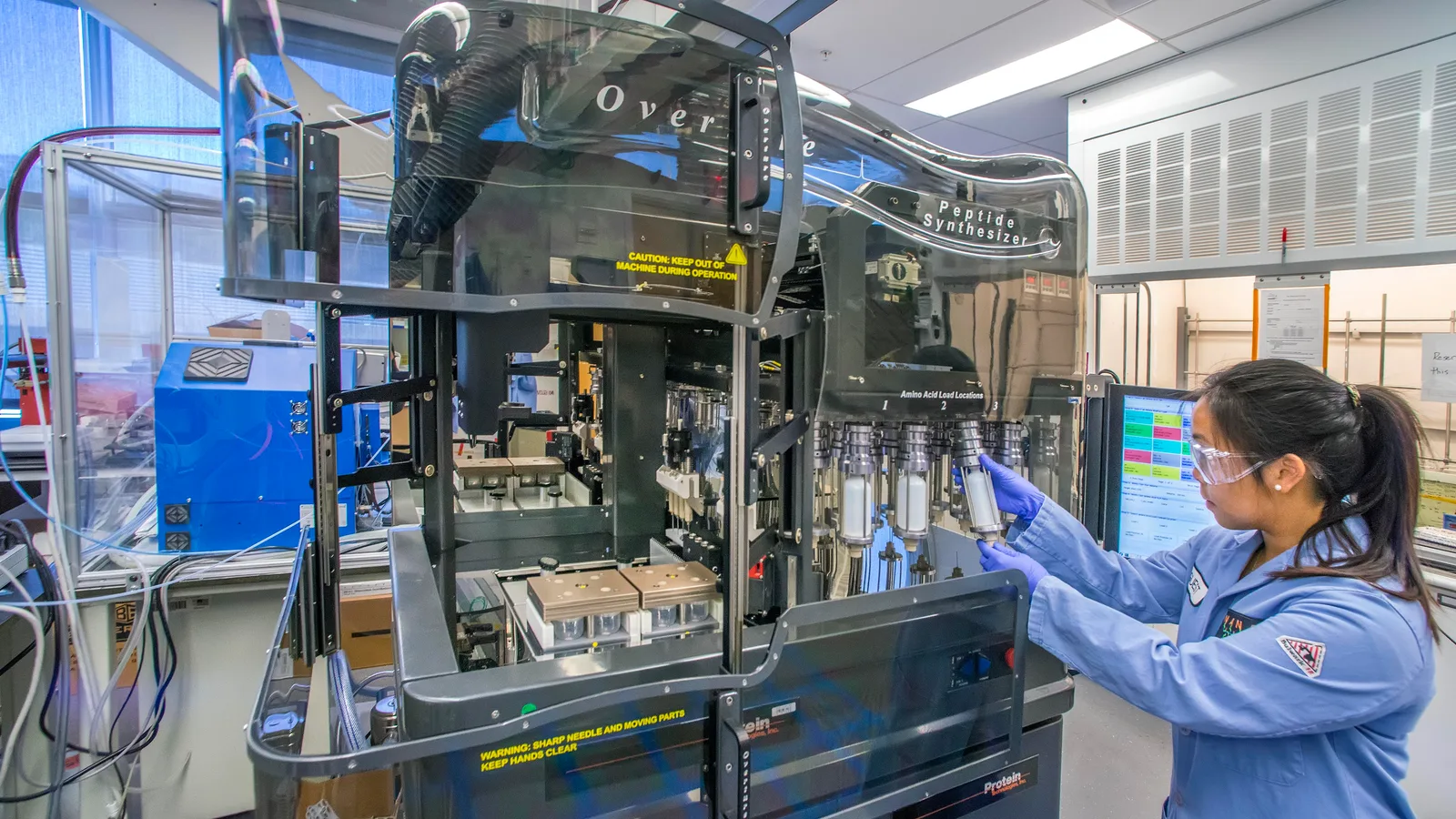
Tirzepatide is a 39-residue synthetic peptide whose C-terminus is an amide and one of whose two lysines carries a branched synthetic side chain ending in a twenty-carbon fatty diacid. The European assessment record states the structure precisely: a peptide based on the GIP sequence containing aminoisobutyric acid at positions 2 and 13, a C-terminal amide, and a Lys20 whose ε-amino group is attached to 1,20-eicosanedioic acid through a linker built from a γ-glutamate and two 8-amino-3,6-dioxaoctanoic acid units (EMA (CHMP), Assessment Report: Mounjaro, EMA/791310/2022, 21 July 2022, p. 13). The discovery paper gives the same architecture (T. Coskun et al., Molecular Metabolism 2018, 18, 3–14), as does the approved US label (FDA, MOUNJARO (tirzepatide) injection — prescribing information, §11).
One boundary has to be set first. Publications and patents disclose development routes and process concepts; they do not necessarily describe Eli Lilly's current commercial manufacturing process. That matters unusually much here, because the public record holds three different things — a peer-reviewed kilogram-scale hybrid route, a patent family disclosing both a linear and a convergent route, and a regulator's description of the process registered in 2022 — which do not all describe the same chemistry.
The argument in one sentence: tirzepatide is difficult to manufacture not because any single reaction is unprecedented — none is — but because sequence fidelity, stereochemical integrity, site-specific lipidation and purification selectivity must all hold at once across a long, chemically heterogeneous peptide. A small failure in any one of them can produce a final-product impurity of the right length and nearly the right mass that is hard to remove.
Tirzepatide Is Both a Peptide and a Site-Specific Conjugate
The object being manufactured is a sequence plus a defined attachment, at a defined position, of a defined side chain — and that second half carries its own supply chain, impurity profile and analytical burden. The EPAR's systematic chemical name resolves its topology exactly: read outward from the Lys20 ε-nitrogen, the linker runs AEEA → AEEA → γ-glutamate → C20 diacid, with the glutamate attached through its γ-carboxyl, its α-amine acylated by the diacid and its α-carboxyl left free. The originator patent writes the same connectivity as two [2-(2-amino-ethoxy)-ethoxy]-acetyl units, one γGlu, and CO–(CH₂)₁₈–CO₂H (US9474780B2, GIP and GLP-1 co-agonist compounds, Eli Lilly and Company, priority 9 January 2015, granted 25 October 2016). Two documents agreeing on the order matters, because a linker assembled in the wrong sequence is a different molecule of very similar mass.
Reading the same name yields facts that shape the manufacturing problem and that summaries usually omit. The sequence contains two lysines: Lys20 carries the side chain, and Lys16 is unmodified in the defined structure. It contains no cysteine and no methionine, which bounds the impurity space in two specific ways — no disulfide bond to form and control, and methionine oxidation not a pathway for this sequence. It does not follow that oxidation is absent as a risk: Trp25 and the two tyrosines remain oxidation- and alkylation-sensitive. Four residues are glycine and two are Aib, all achiral — the EPAR records L-configuration for the natural amino acids and no chiral centre for Gly or Aib.
| Structural feature | Manufacturing consequence | Control implication | Evidence level |
|---|---|---|---|
| 39 residues, amidated C-terminus | ~38 couplings and a similar number of deprotections, each an opportunity for a defect | Stepwise completion monitored, not assumed | Official; step count is arithmetic |
| Aib at positions 2 and 13 | A hindered acylating agent and, once installed, a hindered amine to acylate | Product-specific conditions at and around those positions | Positions official; both disclosed routes single out Ile12→Aib13 |
| Aib and Gly have no chiral centre | Six positions cannot epimerise; the relevant set is the other 33 chiral α-carbons plus the side-chain γGlu centre | Stereochemical control is position-specific | Achirality stated in the EPAR; count derived from the name |
| Two lysines; Lys20 is the defined site | Selective acylation has to be engineered, which is why orthogonal protection is used | Orthogonal protection at Lys20; Lys16 held until final cleavage | Both lysines in the EPAR name. A Lys16-acylated species is structurally plausible if orthogonality is lost, not an impurity shown in the sources reviewed |
| Branched side chain at Lys20 | A second synthesis and supply chain feeding one molecule | Its own specification and change control | Composition official; conjugation expectations in the EMA guideline |
Table 1. Structural features of tirzepatide, what each costs in manufacture, and how strong the public evidence is for each link.
A 39-Residue Sequence Creates a Cumulative Assembly Problem
Stepwise synthesis has a property a convergent route does not: every cycle multiplies. A way to see the scale, without pretending it is a yield prediction:
overall idealised full-length fraction ≈ (stepwise success rate)^(number of assembly events)
For a linear 39-mer there are about 38 backbone couplings. At an idealised 99.5% per coupling, 0.995³⁸ ≈ 83%; at 99.0%, 0.990³⁸ ≈ 68%. Counting deprotections as separate opportunities roughly doubles the exponent: 0.995⁷⁶ ≈ 68%, 0.990⁷⁶ ≈ 47%. Run backwards, the demand is legible — holding 90% of chains intact across 38 couplings needs about 99.72% per step.
Those numbers are an illustration, and wrong in several directions at once. The steps are neither independent — aggregation makes one bad coupling more likely to be followed by another — nor equally efficient, since the disclosed routes apply different conditions at specific positions precisely because the average does not hold there. The expression also covers only chain assembly, saying nothing about losses at cleavage, side-chain installation, precipitation, chromatography or isolation.
A disclosed kilogram-scale figure is the corrective: in the originator process patent, the linear SPPS example on Sieber amide resin reports 14.5 kg of tirzepatide isolated at greater than 97.7% HPLC purity and 88.4% peptide content, at 46% overall yield based on resin loading (WO2020159949A1, Process for preparing a GIP/GLP1 dual agonist, Eli Lilly and Company, priority 29 January 2019, published 6 August 2020, Example 4B). The same example is more revealing before purification: for two batches described at a 32 kg scale for Preparation 24, the patent reports 24.4 kg and 21.3 kg of crude material at 69.5% and 88.3% HPLC purity, respectively. These are the applicant's figures for that disclosed example, not general properties of the molecule. The gap between a crude in the 70–90% range and a released substance above 97% is the work the purification train has to do.
The peptide literature makes the point bluntly — because solid-phase synthesis is stepwise with errors compounded through the synthesis, it does not compete with the templated fidelity of biological expression (R. Behrendt, P. White, J. Offer, Advances in Fmoc solid-phase peptide synthesis, J. Pept. Sci. 2016, 22, 4–27). That gap is why therapeutic peptide development and peptide process development are not separable: sequence decisions made in discovery set the assembly burden permanently.
Why Long-Chain SPPS Becomes Harder at Scale
The difficulties of long-chain solid-phase synthesis are not a scaled-up version of the milligram-scale ones: some appear only when the chain is long, others when the reactor is large. Resin-bound aggregation is a general and often important one, though the sources reviewed here do not establish it as the dominant failure mode in tirzepatide manufacture specifically. As a chain grows, hydrogen bonding between resin-bound peptides collapses the solvated state and the growing N-terminus becomes less accessible. The Fmoc review frames this as the reappearance of poor peptide solubility on the resin and concludes that the major obstacle to peptide synthesis is peptide aggregation — a theme developed at length in the difficult-sequence literature (M. Paradís-Bas, J. Tulla-Puche, F. Albericio, The road to the synthesis of "difficult peptides", Chem. Soc. Rev. 2016, 45, 631–654). Aggregation is not a separate impurity mechanism but the multiplier on the others: an inaccessible amine gives incomplete coupling and a deletion, a shielded Fmoc group gives incomplete deprotection and a different deletion elsewhere.
The standard mitigations are structural rather than procedural: backbone amide protection and pseudoproline dipeptides both break the hydrogen-bonded secondary structure, and have been compared for difficult sequences (S. C. F. Sampson, W. Patsiouras, N. J. Ede, J. Pept. Sci. 1999, 5, 403–409). Not hypothetical here: the process patent's N-terminal fragment is built with a Gly-Thr pseudoproline dipeptide covering positions 4 and 5.
Scale adds constraints unrelated to sequence. Solid-phase synthesis consumes solvent and reagent in proportion to resin volume rather than product mass — the reason greener peptide API processes were named a critical unmet need (A. Isidro-Llobet et al., J. Org. Chem. 2019, 84, 4615–4628) — and mass transfer into a swollen polymer is not improved by stirring harder, so a coupling validated in the laboratory can behave differently in a production reactor, the same technology-transfer problem that governs small-molecule API scale-up.
One structural difference changes the control philosophy. In a conventional synthesis a bad step is caught at the next isolation; in linear SPPS there is none until cleavage, so the only information available during assembly is what the in-process controls see on resin — which is why the disclosed examples specify targets such as greater than 99% Fmoc removal confirmed by UV, and residual protected lysine under 1% before the side chain is attached.
Non-Natural Residues Change Both Chemistry and Material Control
Aib — 2-aminoisobutyric acid, or 2-methylalanine — is alanine with a second methyl group on the α-carbon, and that does two things at once.
Chemically, α,α-disubstitution makes the residue hindered on both sides: Fmoc-Aib-OH is a hindered acylating agent, and once installed its α-amino group is a hindered nucleophile the next residue must acylate. Two independent originator disclosures, both describing tirzepatide itself and both using the same residue numbering, treat one junction differently from its neighbours. The compound patent's laboratory example couples Fmoc-Ile-OH at position 12 with PyBOP and DIEA for 24 hours at 25 °C against a 90-minute default — the coupling onto Aib13. The process patent's kilogram-scale linear example records that when the process was globally switched from NMP to DMF, the Ile12-to-Aib13 coupling was the single step where NMP was retained. Two disclosures treating that junction with reinforced coupling is product-specific evidence that it received additional process attention. It is not evidence that the bond cannot be formed under ordinary conditions, nor that every route to tirzepatide must treat it this way.
The same patent names where else that example needed help, stating that "Extended couplings (4h each) for Pro31, Trp25, Gln24, Val23, Phe22, Lys20, Gly4, Glu3 and Aib2" are necessary to improve the quality of the crude peptide — nine positions out of 39, clustered around the Phe22–Pro31 stretch and near Aib2. That is the applicant's statement about its own procedure, in a document stating that its examples are not limiting: a window onto which positions resisted in that route, not a universal requirement.
Stereochemically, Aib does the opposite of what "non-natural residue" might suggest: with two identical methyl groups on its α-carbon it has no chiral centre and cannot epimerise, as the EPAR states. The epimerisation-relevant set is therefore the 33 chiral α-carbons of the natural residues plus the side chain's (22S) γ-glutamate centre. The β-centres of the three isoleucines and two threonines are set by the building block rather than the coupling, making them a raw-material attribute.
Aib is also not a commodity: non-proteinogenic building blocks have their own routes, suppliers and related-substance profiles, and a change in any is a change to the drug substance process. The adopted European guideline requires that starting-material impurities capable of reacting like the parent compound during coupling be controlled and limited in the starting-material specification, with their fate and purge assessed (EMA, Guideline on the Development and Manufacture of Synthetic Peptides, EMA/CHMP/CVMP/QWP/367182/2025, adopted 4 December 2025, in effect 1 June 2026). That is the same reactivity-first logic governing raw-material qualification in oligonucleotide manufacture, and it transfers for one reason: both platforms assemble a product from repeated building-block additions, so an incorporable building-block impurity becomes a product-related impurity rather than a process one. The platforms are not otherwise equivalent — chemistries, linkages and analytical problems all differ.
Starting-material selection runs on ICH Q11, whose solid-support clause notes that where peptides are built on a resin "there is a more limited relationship between risk and number of steps from the end of the manufacturing process" (ICH, Q11, Step 4, 1 May 2012) — so an early building-block defect here is not automatically low-risk. Two building-block attributes deserve naming because a routine purity method does not see them: acetic acid carried in an Fmoc-amino acid caps the growing chain permanently and is not detected by RP-HPLC, with levels below 0.02% required for clean assembly; and free amino acid in the derivative can cause a residue to be incorporated twice, giving an insertion sequence. Both are documented in the Fmoc review.
Lys20 Is a Manufacturing Junction
Much of what is difficult about this molecule concentrates at one residue. The requirement: acylate the ε-amine of Lys20, not that of Lys16 and not the N-terminal α-amine, while the rest stays protected. That needs a protecting group on Lys20 removable under conditions leaving every other protecting group standing — orthogonality in the strict sense, not merely different lability.
The record shows two orthogonal solutions from the same originator. The compound patent uses Fmoc-Lys(Alloc)-OH, removes the allyloxycarbonyl group with catalytic Pd(PPh₃)₄ and phenylsilane, then extends the side chain in four on-resin steps. The process patent uses Fmoc-Lys(ivDde)-OH, removed with 8% hydrazine hydrate in DMF over four hours — monitored to leave under 1% of the protected form, with eight DMF washes to clear residual hydrazine — then couples the whole side chain as one preformed building block. Lys16 carries a Boc group, removed only in the final acidolysis.
The differences are not cosmetic. A palladium-mediated deprotection introduces a metal catalyst, and the European guideline lists elemental impurities among specification attributes where metal catalysts are used; a hydrazine-mediated one introduces a reactive, toxicologically significant reagent that must be cleared before an activated ester is introduced — hence eight washes rather than a nominal rinse.
Three failure modes sit at this junction. Incomplete removal of the Lys20 protecting group, or incomplete acylation after successful removal, both leave chains without a side chain — the European guideline lists free unconjugated peptide as an additional quality attribute for conjugated peptides — but they have different control points, deprotection kinetics in one case and reagent stoichiometry in the other. Over-reaction gives doubly acylated material, which the guideline names for PEG as di- or multi-conjugation and treats as a general conjugation risk. And if orthogonality were lost — premature or partial loss of the Lys16 protecting group before acylation — a second nucleophile would be exposed. A Lys16-acylated species is a structurally plausible consequence of lost orthogonality, not an impurity shown in the public sources reviewed here; the guideline notes in general terms that non-site-specific conjugation products may occur and should be controlled.
That last case is where the analytical argument becomes concrete, because of what it would cost to detect. A doubly acylated chain differs in mass and is caught by intact-mass analysis; a wrong-site species would not be, sharing the product's molecular formula. Observing the expected molecular weight does not by itself establish that the side chain is on the intended lysine. That requires a method which localises the modification — peptide mapping with MS/MS, or a separation against a reference standard. The EPAR records structure elucidation by LC-MS, LC-MS/MS of the intact molecule, LC-MS peptide mapping, chiral GC-MS, RP-HPLC and IC, NMR, CD, FT-IR, light scattering and cell-based bioassays: an orthogonal set, not a single mass measurement.
One feature of the registered process deserves careful statement. The EPAR describes the active substance as made by "a standard solid phase peptide synthesis (SPPS) manufacturing procedure including addition of the linear sidechain at Lys20", the peptide then cleaved from resin with simultaneous side-chain deprotection. The side chain therefore goes on while the peptide is still on resin, so there is no isolated unconjugated peptide to release-test. The European guideline addresses exactly this, treating the unconjugated peptide as an intermediate whose control is essential and stating that where none is isolated the approach should be justified and a control strategy developed. On-resin conjugation is legitimate; it shifts the burden onto in-process control and final-product analytics.
The Lipid Side Chain Is a Critical Intermediate of Its Own
The C20 diacid does not arrive as a reagent. In the disclosed process route it arrives fully assembled and orthogonally protected: the patent couples the resin-bound peptide with t-butyl-eicosanedioyl-Glu-(O-tert-butyl)-(8-amino-3,6-dioxaoctanoic acid)-(8-amino-3,6-dioxaoctanoic acid)-OH. That is a four-component molecule with a defined internal order, a stereocentre, two protecting groups and a free carboxyl for activation — a small synthesis in its own right, whose preparation in the patent reports a crude containing 52.3 area% of the desired product before chromatography and crystallisation.
Several impurity classes belong to this building block rather than to the peptide. A single- or triple-AEEA analogue, or a construct with two glutamates rather than one, differs by a defined increment and, once coupled, gives a full-length peptide with the wrong side chain — the originator patent's own claims include a two-γGlu variant, so such architectures are chemically accessible. The glutamate stereocentre is fixed by the building block and carried through unchanged. The acylating species is an activated ester formed in situ, and residual activated material can acylate elsewhere. And incomplete removal of the tert-butyl esters in the final acidolysis gives a correctly conjugated peptide carrying an extra 56 mass units — a product-related impurity that no amount of correct assembly prevents.
The regulatory treatment is more demanding than the building block's size suggests. The European guideline states that an activated derivative may not be suitable as a starting material and may itself be an intermediate, that the conjugation chemistry must be described in process development, that "conjugatable versus non-conjugatable impurities" should be identified by risk analysis, and that where the linker comes from multiple suppliers, separate documentation and a compiled specification are expected. The side chain is therefore not a purchased reagent with a certificate of analysis but a controlled intermediate with its own change-control obligations, feeding the most consequential step in the process.
What the Hybrid SPPS/LPPS Route Changes
A publicly reported kilogram-scale hybrid route exists. A team from Eli Lilly's Indianapolis and Kinsale sites reported a kilogram-scale GMP process in which four fragments were prepared by solid-phase synthesis and joined in solution, with continuous operation, real-time analytical monitoring and nanofiltration for intermediate purification (M. O. Frederick et al., Org. Process Res. Dev. 2021, 25, 1628–1636). That paper is paywalled and was available to this article only at abstract level, so what follows about its unit operations is abstract-level evidence. A later paper from the same organisation describes a "four-fragment convergent hybrid SPPS/LPPS strategy" which its authors say they pioneered in order to enable the commercial synthesis of tirzepatide — their statement of why the strategy was developed, not a statement that it is the process now in use — and adds a two-fragment route using native chemical ligation and tandem desulfurization, with tangential flow filtration between the operations and ligation reported to proceed "without epimerization" (A. Jalan et al., Angew. Chem. Int. Ed. 2026, 65(6)). Its full text was likewise not accessible.
The process patent shows the machinery: fragment couplings as feed streams combined in mixers and passed through plug-flow reactors with defined residence times — two hours for a coupling at 20 °C, one for the subsequent diethylamine-mediated Fmoc removal — with nanofiltration between couplings for ten to twenty diavolumes, stripping coupling reagent, base and dibenzofulvene before the next fragment enters. The applicant's stated aim is "an efficient route having fewer steps".
Where the fragments are cut is where the record thins, and it is worth being strict. The 2021 abstract says the four fragments chosen were those of highest purity and most readily isolable; it does not give their boundaries, and without the full text this article does not state them. Other disclosures name junctions, but they are different disclosures and should not be merged into one scheme: the process patent's sequence listing shows segments corresponding to residues 22–30 and 31–39 and an N-terminal Boc-Tyr1 to Leu14 with a Gly-Thr pseudoproline, while a 2025 paper from the same organisation works on a C-terminal segment defined as residues 30–39 (P. Agrawal et al., Org. Process Res. Dev. 2025, 29, 2896–2907). A separate group has published a hydrophobic-tag liquid-phase route (Z.-J. Pang et al., Org. Lett. 2025, 27, 10442–10446), and the originator has disclosed that the lipid moiety can be attached before or after fragment assembly (EP4017866A1, Eli Lilly and Company, priority 19 August 2019 — whose examples concern incretin analogs generally, not tirzepatide). The conclusion available from that spread is not a fragment map: fragment strategies redistribute risk and may choose different junctions, and a junction is a design decision about where a coupling can be made cleanly. Continuous operation now has its own framework too — the European guideline points such approaches to ICH Q13, adopted November 2022, after the 2021 paper appeared.
| Linear SPPS | Hybrid SPPS/LPPS (as disclosed) | |
|---|---|---|
| Assembly | One resin-bound chain, ~38 sequential couplings | Four shorter chains built in parallel, then joined in solution |
| Intermediate isolation | None between loading and cleavage | Each fragment isolated and released before coupling |
| Where errors accumulate | Across the whole chain; a defect anywhere travels to the end | Within a fragment, where it can be rejected |
| New risks introduced | — | Epimerisation at each activated fragment C-terminus; incomplete coupling; reagent carry-over |
| Reported anchor figures | 14.5 kg at >97.7% purity, 46% yield on resin loading, in the patent's example | Kilogram-scale GMP manufacture reported in 2021; per-step figures not accessed |
| What a regulator has described | The 2022 EMA assessment report describes the EU registered process as standard SPPS with on-resin side-chain addition at Lys20 — that assessment, at that date; not proof of the route used for every batch or region today | No EU assessment of a hybrid route for this product was reviewed here; the 2025 EMA peptide guideline treats hybrid approaches as acceptable and expects comparability data where processes run in parallel |
Table 2. Linear versus hybrid assembly, from the disclosed routes. Figures are as reported in the cited documents, not general properties of either approach.
Hybrid manufacture redistributes risk; it does not remove it. Every fragment coupling activates a peptide at its C-terminal residue, the classical condition for epimerisation there — which is why a claim of ligation without epimerisation is worth stating, and why native chemical ligation is attractive. That chemistry joins unprotected fragments chemoselectively in aqueous solution through a cysteine at the junction (P. E. Dawson, T. W. Muir, I. Clark-Lewis, S. B. H. Kent, Science 1994, 266, 776–779), and tirzepatide has no cysteine. The originator process patent reconciles that in its own words: it describes native chemical ligation as useful for peptides containing a cysteine or an alanine, proceeding through a transient thioester-linked intermediate that rearranges to a native bond, and its own worked ligation example for tirzepatide runs a peptide hydrazide through thiolysis to a thioester and then a radical, transition-metal-free desulfurization. An alanine-site ligation followed by desulfurization is therefore documented chemistry for a sequence with no cysteine — though which alanine is not established from the sources accessible here.
The evidence boundary has to be drawn carefully, because the documents say different things. The 2021 paper reports kilogram-scale GMP manufacture by a hybrid route; the 2026 paper's authors give enabling commercial synthesis as their reason for developing the four-fragment strategy; the CHMP assessment supporting the 2022 European authorisation describes the registered active-substance process as standard SPPS with side-chain addition at Lys20 on resin. These are not necessarily in conflict — processes change over a product's life, and an assessment report describes what was registered at that date — but they are different claims about different things, and nothing in the public record reviewed here establishes which route is in current commercial use. Where more than one active-substance process runs in parallel, the European guideline expects comparability data on the active substance.
Fragment quality then becomes final-product quality. Each fragment needs an identity, a purity, a content and an unambiguous terminal state — which protecting group is on which end, and whether any is lost. A fragment carrying a deletion becomes a full-length-minus-one final product once coupled; one epimerised at its activated C-terminal residue becomes a diastereomer; one that is 1% short-coupled contributes that 1% to the final impurity profile, with no later step that removes it preferentially. Incomplete fragment coupling leaves the preceding fragment as a truncated species close in properties to the product, and residual activated species carried forward can acylate the wrong nucleophile — which is why the disclosed route quenches with acetic acid and then nanofilters. Homologous fragments differing by one residue are hardest to control, because a specification set on total related substances cannot distinguish a harmless impurity from an incorporable one.
An Impurity Map for Tirzepatide Manufacture
The taxonomy below follows the adopted European guideline, which divides peptide-related impurities by origin — starting materials, formation during manufacture, degradation during manufacture or storage — and separates them from non-peptide impurities such as reagents, solvents, elemental impurities and nitrosamines. Two cautions apply to every row. The presence of a mechanism here is not evidence that the impurity occurs at a material level in tirzepatide — the mechanisms are general peptide chemistry, and where a source ties one to this molecule the table says so. And the EPAR, while recording that impurities above the ICH Q3A qualification threshold were qualified, does not publish the list, so no row should be read as the registered specification.
| Stage | Impurity family | Plausible mechanism | Product consequence | Best control point | Analytical confirmation | Evidence level |
|---|---|---|---|---|---|---|
| Raw material | Incorporable building-block impurities, and the insertions they cause | Wrong enantiomer or diastereomer; Ile for Leu; β-Ala derivatives; free amino acid coupling a residue twice; acetic acid capping a chain | Stereoisomer; peptide of identical nominal mass; duplicated residue; capped truncated chains | Building-block specification | Chiral GC-MS; MS/MS; RP-HPLC misses acetic acid | EMA guideline and Fmoc review; tirzepatide has three Ile, two Leu |
| Assembly | Deletion and truncated (capped) sequences | Incomplete coupling or deprotection at any cycle; failed chains then acetylated | Chain missing residues at any of many positions; capped chains more separable | Coupling IPCs; recoupling; reinforced conditions where positions resist | RP-HPLC with MS; peptide mapping to locate | General; two originator disclosures reinforce Ile12→Aib13, one naming nine extended-coupling positions in its own example |
| Assembly | Epimerisation | Oxazolone formation at an activated α-carbon | Diastereomer of the product | Urethane protection; additives; temperature; activation time | Chiral GC-MS; LC against epimer standards | General; EPAR records chiral GC-MS |
| Assembly | Aspartimide and ring-opened products | Base-mediated cyclic imide at Asp, then hydrolysis or amine attack | α/β-isomers and epimers, several near-isobaric | Asp protection; base composition; exposure time | RP-HPLC with authentic standards | General; occurrence here not established |
| Assembly | Depsipeptide isomers | Ester rather than amide linkage; exact position not established in the published text | Isomer of the product, same molecular formula | Base-mediated conversion back to product (pH 8.5–9.5), not removal | Chromatography; conversion behaviour | Named, quantified at 10–15% of crude, and claimed in WO2020159949A1 |
| Fragment coupling | Fragment-related variants | Incomplete coupling; a flawed fragment carried in; residual activated species | Large truncated species, or a full-length diastereomer or deletion variant | Fragment release testing; quench and nanofiltration | Fragment-level LC-MS; final peptide mapping | Hybrid route only; levels not published |
| Lipidation | Conjugation extent and site: unconjugated peptide, multiple conjugation, wrong-site acylation | Incomplete Lys20 deprotection or acylation; over-acylation; loss of Lys16 orthogonality | No side chain; a doubly acylated chain (mass differs); or a Lys16-acylated species sharing the product's formula | Deprotection and acylation IPCs; stoichiometry; protection integrity | Intact mass for the first two; MS/MS peptide mapping to localise | Named generally in the EMA guideline; no Lys16-acylated tirzepatide impurity reported in the sources reviewed |
| Lipidation | Linker-composition variants | Wrong AEEA count, glutamate count or order in the building block | Full-length peptide with an altered side chain | Side-chain intermediate specification | LC-MS of the building block; MS/MS of the product | Related architectures in the patent claims |
| Cleavage | Alkylated side chains; incomplete deprotection | Protecting groups released as reactive cations; residual tert-butyl or Boc | Modified Trp or Tyr; or a defined mass increment | Scavenger cocktail; cleavage time | RP-HPLC with MS; intact mass | EMA guideline; Trp mitigation documented (Fields & Fields 1993) |
| Purification / storage | Degradation products and high-molecular-weight species | Oxidation, hydrolysis, isomerisation, deamidation, diketopiperazine and pyroglutamate formation; dimers and oligomers; self-association | Various; plus species larger than the target | Hold times; temperature; solvent; concentration; storage | Stability-indicating methods; SEC | EMA guideline pathway list; SEC in the EPAR specification; EPAR records no degradation on storage |
Table 3. An impurity map by manufacturing stage. Bold entries have product-specific public evidence; the rest are general mechanisms whose relevance here requires product-specific confirmation.
The depsipeptide row is the clearest product-specific case in the record, and the patent is specific enough to read closely. In the disclosed linear example the crude is dissolved in 1:1 acetonitrile/water and the pH raised to 8.5–9.5 with ammonium hydroxide to initiate the conversion of depsi peptide isomers, stated at 10–15% of the crude, to tirzepatide, with at least an hour's hold; the claims generalise this to pH 7–10. The patent's word is conversion, not removal: a depsipeptide is an ester-linked isomer sharing the product's molecular formula, and the disclosed step turns it back into product rather than separating it out. The same dissolution hold also converts a tryptophan CO₂ salt to tirzepatide, over at least seven hours in total. Two limits on what this supports. The patent refers to isomers in the plural and defines them by a sequence identifier whose structure is not machine-readable in the published text, so the public disclosure reviewed here does not establish that the same ester linkage or formation pathway applies across every tirzepatide route; and no conversion yield is reported, so nothing implies quantitative recovery. Tirzepatide does have five serines and two threonines, where such an ester could sit.
Why Purification Cannot Repair Every Upstream Error
Reversed-phase chromatography separates on hydrophobicity: it works well when a failure product differs in that respect and poorly when it does not.
The favourable cases are real: a truncated, acetylated chain missing several residues, or one carrying a second C20 chain, differs enough to be resolved on a well-developed preparative method — a mature discipline with a literature on loading, selectivity and recovery (R. S. Hodges, T. W. Lorne Burke, C. T. Mant, J. Chromatogr. A 1988, 444, 349–362) and on the stationary phases built for it (L. F. Lloyd, M. B. Millichip, C. M. Watkins, J. Chromatogr. A 2002, 944, 169–177).
The unfavourable cases define the control strategy. A single-residue deletion in a 39-mer changes hydrophobicity slightly; an epimer changes it less; a side-chain positional isomer or a depsipeptide isomer changes composition not at all. For the aspartimide family, the Fmoc review is direct: the piperidide by-products are in most cases easily separated by RP-HPLC, but "resolution of the epimerised α-aspartyl peptide is very difficult or impossible" — the review's own assessment for its context, and the sharpest published statement of the limit (see also R. Subirós-Funosas, A. El-Faham, F. Albericio, Tetrahedron 2011, 67, 8595–8606; on racemisation and aspartimide under forcing conditions, S. A. Palasek, Z. J. Cox, J. M. Collins, J. Pept. Sci. 2007, 13, 143–148).
The European guideline builds this into its expectations rather than treating it as a deficiency: complete separation of the desired peptide from structurally related pre- and post-eluting impurities is not always achieved, so fractions are collected and the highest-purity ones pooled, lower-purity side fractions may be repurified under separate acceptance criteria, and routine repurification counts as manufacturing rather than reprocessing — falling within process validation.
Purification is a selectivity budget, not a filter: widening a collection window to recover yield admits more closely related species, and narrowing it discards product. The disclosed linear route spends two sequential reversed-phase purifications, tangential flow filtration, co-feed precipitation and a humidification step to get from a 70–90% crude to above 97.7% at 46% yield. That arithmetic is why prevention upstream — a better coupling, a cleaner building block, an intermediate that can be rejected — is generally worth more than resolution downstream.
Analytics Must Resolve More Than Molecular Weight
The analytical package answers four different questions, and conflating them is the commonest error in reading a certificate of analysis.
Detection asks whether a species is visible at all; the guideline asks for highly specific methods with an appropriate lower range limit. Identification asks what it is, and intact mass narrows the field without closing it: it cannot distinguish a depsipeptide isomer, an Ile-for-Leu substitution or an epimer, because all three share the product's molecular formula. Localising a modification requires fragmentation — MS/MS sequencing, or peptide mapping. Quantitation asks how much, and there reference standards become load-bearing: a peak can be integrated without one, but assigning it a concentration and a limit generally cannot. Qualification asks whether a level is acceptable on safety grounds — a toxicological and clinical question, not an analytical one.
That last point needs care, because the threshold boundaries are not automatic. ICH Q3A(R2) states in its own preamble that peptides are among the drug-substance types not covered (ICH, Q3A(R2), Step 4 version, 25 October 2006), and the 2025 European peptide guideline exists partly because synthetic peptides fall fully or partly outside ICH Q3A/B, Q6A/B and M7. The 2022 EPAR nonetheless records qualification against the Q3A threshold for this product. Both hold: small-molecule thresholds are not automatically applicable to a complex synthetic peptide, and a specific assessment may still conclude that applying them is justified. What is not defensible is transferring them by default.
Stereochemistry has its own methodological trap, and the guideline's solution is elegant. Chiral GC after acid hydrolysis is the standard way to quantify D-amino acid content, but hydrolysis itself induces some epimerisation, so the analysis would measure a defect it had just created. The guideline describes performing the hydrolysis in deuterated hydrochloric acid, so that epimerisation occurring during hydrolysis yields deuterated amino acids distinguishable by a mass spectrometric detector in tandem with the chiral GC.
From Raw Materials to What Must Be Demonstrated
Read together, the sources describe a control strategy distributed across the process rather than concentrated at release. Protected amino acids carry specifications reaching attributes a routine purity method does not see — enantiomeric and diastereomeric content, β-alanyl species, free amino acid, acetic acid. Aib and the lipid side-chain intermediate are non-commodity inputs whose supplier or route changes are drug-substance changes. Resin loading — around 0.65–0.76 mmol/g in the disclosed examples — is a process parameter with impurity consequences, not a catalogue number. The Lys20 orthogonal step carries its own residue question, palladium in one route and hydrazine in the other, and process parameters include solvent identity at specific positions, flow residence times and storage of resin-bound intermediates at −20 °C. Final release, per the EPAR, covers identity by RP-LC-UV, peptide map and cell-based bioassay; assay; purity by RP-LC-UV and RP-LC-MS; high-molecular-weight species by SEC; residual solvents; water; endotoxins; and microbiological purity.
The questions below separate that by who can answer them; treating them all as a supplier questionnaire misassigns work only the process owner can do.
| Control question | Responsible party | Evidence expected |
|---|---|---|
| Which impurities here can be incorporated during coupling, how are they limited, and by what methods are enantiomeric content, free amino acid and acetic acid measured? | Building-block supplier | A reactivity-based classification with individual limits, not one total figure; methods that see what a purity assay does not |
| Where does the process resist, and what conditions are applied there? | Peptide manufacturer / CDMO | Position-level knowledge — which couplings are extended, which solvent is retained where, and why |
| How is completion of the Lys20 deprotection and acylation established, and how is it shown that the side chain is on Lys20 rather than Lys16? | Peptide manufacturer / CDMO | Quantitative IPCs with numerical targets, plus a method that localises the modification |
| Which impurities rely on final purification, which must be controlled upstream, and if a second route runs in parallel, what comparability data support it? | Sponsor / process owner | A fate-and-purge assessment per impurity family; active-substance comparability, and finished-product comparability for complex peptides |
| How are changes to route, building-block supplier or protecting-group strategy assessed? | Quality agreement | Notification obligations and a stated requirement to re-establish the impurity profile |
| Can the methods distinguish isobaric variants — epimers, depsipeptides, Ile/Leu substitutions? | Sponsor and manufacturer jointly | Demonstrated resolution against authentic standards, not an assertion of specificity |
Table 4. Control questions for tirzepatide-class manufacture, grouped by who can actually answer them.
Conclusion
The difficulty of manufacturing tirzepatide comes from none of chain length, lipidation or purification alone, but from the coupling between them.
A long chain means many events, each with a small failure probability that compounds. A hindered non-natural residue means the average coupling condition does not hold everywhere, and the originator's own documents name where it did not in their examples. A second, unmodified lysine means selective acylation has to be engineered rather than assumed. A branched side chain means a second supply chain feeding the most consequential step. And a purification that separates on hydrophobicity means the failure products most similar to the product — the epimer, the depsipeptide isomer, the isobaric substitution — are the least likely to be removed.
The consequence is a control strategy that has to be distributed rather than concentrated. A small deviation in a building block, a deprotection or a coupling rarely announces itself as a gross failure; it converts into a final-product impurity of the right length and nearly the right mass, structurally different and difficult to clear. Which is why the most informative question about such a process is not what purity it reaches, but which errors it can no longer make.
Frequently Asked Questions
Is tirzepatide manufactured by recombinant expression or chemical synthesis?
Chemical synthesis. The European assessment report describes the active substance as a 39-amino acid synthetic peptide made by solid-phase peptide synthesis with chromatographic purification. Two of its residues and the entire Lys20 side chain are not encodable, so a purely recombinant route would not produce the molecule without further chemical steps.
Why is a 39-residue peptide difficult to synthesise consistently?
Because stepwise assembly compounds: roughly 38 couplings and a similar number of deprotections each have to succeed at very high efficiency for most chains to reach full length, and the failure products are sequence variants rather than obviously different compounds. In a linear route there is also no isolated intermediate at which a bad step can be caught.
Why is tirzepatide lipidated at a specific lysine?
The C20 fatty diacid enables albumin binding, which extends the half-life and supports once-weekly dosing — the discovery paper and the prescribing information both state this. In manufacturing terms the requirement is selectivity: the molecule contains two lysines, Lys20 is the defined site, and Lys16 is unmodified in the defined structure. The disclosed routes use an orthogonal protecting group on Lys20 — Alloc removed with a palladium catalyst in the compound patent, ivDde with hydrazine in the process patent — while Lys16 stays protected until final cleavage. Whether a Lys16-acylated species ever forms at a material level is not reported in the sources reviewed here.
What does hybrid SPPS/LPPS improve compared with a fully linear route?
In the disclosed routes it lets shorter fragments be built in parallel, purified and released before assembly, so a defect inside a fragment can be rejected rather than carried to the end; nanofiltration or tangential flow filtration then removes reagents between solution-phase couplings. It also introduces risks a linear route does not have, principally epimerisation at each activated fragment C-terminus and incomplete fragment coupling. It redistributes risk rather than removing it, and the public record does not establish which route is in current use.
Can final HPLC purification remove all tirzepatide-related impurities?
The sources reviewed here do not support that expectation. The adopted European peptide guideline states that complete separation of the desired peptide from structurally related pre- and post-eluting impurities is not always achieved, and builds fraction pooling and side-fraction repurification into the expected process. Species sharing the product's molecular formula are the least likely to be resolved — which is why prevention and intermediate control carry more of the burden.
References and Further Reading
- EMA (CHMP), Assessment Report: Mounjaro (tirzepatide), EMA/791310/2022, Procedure EMEA/H/C/005620/0000, 21 July 2022
- FDA, MOUNJARO (tirzepatide) injection, for subcutaneous use — full prescribing information, DailyMed SPL (accessed 12 September 2026)
- EMA (CHMP/CVMP), Guideline on the Development and Manufacture of Synthetic Peptides, EMA/CHMP/CVMP/QWP/367182/2025, adopted 4 December 2025, in effect 1 June 2026
- ICH, Q11 Development and Manufacture of Drug Substances (Chemical Entities and Biotechnological/Biological Entities), Current Step 4 version dated 1 May 2012
- ICH, Q3A(R2) Impurities in New Drug Substances, Current Step 4 version dated 25 October 2006
- ICH, Q13 Continuous Manufacturing of Drug Substances and Drug Products, final version adopted 16 November 2022
- US9474780B2, GIP and GLP-1 co-agonist compounds, Eli Lilly and Company; priority 9 January 2015, granted 25 October 2016 — legal status as displayed on Google Patents, not a legal determination
- WO2020159949A1, Process for preparing a GIP/GLP1 dual agonist, Eli Lilly and Company; priority 29 January 2019, published 6 August 2020 — PCT application; national and regional members are separate
- EP4017866A1, Methods of making incretin analogs, Eli Lilly and Company; priority 19 August 2019, published 29 June 2022
- T. Coskun, K. W. Sloop, C. Loghin, J. Alsina-Fernandez, S. Urva, K. B. Bokvist, X. Cui, D. A. Briere, O. Cabrera, W. C. Roell, U. Kuchibhotla, J. S. Moyers, C. T. Benson, R. E. Gimeno, D. A. D'Alessio, A. Haupt, LY3298176, a novel dual GIP and GLP-1 receptor agonist for the treatment of type 2 diabetes mellitus: From discovery to clinical proof of concept, Molecular Metabolism, 2018, 18, 3–14
- M. O. Frederick, R. A. Boyse, T. M. Braden, J. R. Calvin, B. M. Campbell, S. M. Changi, S. R. Coffin, et al., Kilogram-Scale GMP Manufacture of Tirzepatide Using a Hybrid SPPS/LPPS Approach with Continuous Manufacturing, Organic Process Research & Development, 2021, 25, 1628–1636
- A. Jalan, E. S. Murzinski, P. J. Jansen, R. D. Miller, M. C. Embry, R. B. Scherer, J. F. Moomaw, K. M. Williams, C. A. Fisher, J. James, C. A. Arbour, E. J. Guinn, J. Teng, M. E. Kopach, A Convergent Hybrid Gram-Scale Synthesis of Tirzepatide: Tangential Flow Filtration Assisted Native Chemical Ligation-Desulfurization Approach, Angewandte Chemie International Edition, 2026, 65(6)
- P. Agrawal, M. R. Berglund, E. Murzinski Valco, J. Teng, K. D. Seibert, M. E. Kopach, Advancing Peptide Synthesis: Liquid-Phase Assembly of Tirzepatide's C-Terminus (30–39) via Crystalline Pentamer Building Blocks, Organic Process Research & Development, 2025, 29, 2896–2907
- Z.-J. Pang, C.-Y. Mao, T.-T. Feng, L. Dong, Hydrophobic Tag-Assisted Liquid-Phase Synthesis of Tirzepatide, Organic Letters, 2025, 27, 10442–10446
- R. Behrendt, P. White, J. Offer, Advances in Fmoc solid-phase peptide synthesis, Journal of Peptide Science, 2016, 22, 4–27
- M. Paradís-Bas, J. Tulla-Puche, F. Albericio, The road to the synthesis of "difficult peptides", Chemical Society Reviews, 2016, 45, 631–654
- R. Subirós-Funosas, A. El-Faham, F. Albericio, Aspartimide formation in peptide chemistry: occurrence, prevention strategies and the role of N-hydroxylamines, Tetrahedron, 2011, 67, 8595–8606
- S. A. Palasek, Z. J. Cox, J. M. Collins, Limiting racemization and aspartimide formation in microwave-enhanced Fmoc solid phase peptide synthesis, Journal of Peptide Science, 2007, 13, 143–148
- S. C. F. Sampson, W. Patsiouras, N. J. Ede, The synthesis of 'difficult' peptides using 2-hydroxy-4-methoxybenzyl or pseudoproline amino acid building blocks: a comparative study, Journal of Peptide Science, 1999, 5, 403–409
- A. Isidro-Llobet, M. N. Kenworthy, S. Mukherjee, M. E. Kopach, K. Wegner, F. Gallou, A. G. Smith, F. Roschangar, Sustainability Challenges in Peptide Synthesis and Purification: From R&D to Production, The Journal of Organic Chemistry, 2019, 84, 4615–4628
- P. E. Dawson, T. W. Muir, I. Clark-Lewis, S. B. H. Kent, Synthesis of Proteins by Native Chemical Ligation, Science, 1994, 266, 776–779
- G. B. Fields, C. G. Fields, Minimization of tryptophan alkylation following 9-fluorenylmethoxycarbonyl solid-phase peptide synthesis, Tetrahedron Letters, 1993, 34, 6661–6664
- R. S. Hodges, T. W. Lorne Burke, C. T. Mant, Preparative purification of peptides by reversed-phase chromatography, Journal of Chromatography A, 1988, 444, 349–362
- L. F. Lloyd, M. B. Millichip, C. M. Watkins, Reversed-phase poly(styrene–divinylbenzene) materials optimised for large scale preparative and process purification of synthetic peptides, Journal of Chromatography A, 2002, 944, 169–177
Insights
Sourcing or supplying what you just read about?
ChemAbout connects chemical buyers and suppliers worldwide. Tell us what you need, or list what you offer.
Post a purchase request
Free, no sign-up — stays anonymous
List your products
Requires a free company account
Related articles
Article39 min read
Why Phosphoramidite Purity Is Not Enough: Impurity Propagation in Oligonucleotide Manufacturing
A phosphoramidite's headline assay does not describe its manufacturing risk. What matters is whether an impurity can be coupled into a growing chain, at which cycle, what sequence variant it creates, and whether purification and analysis can control the result.

Article25 min read
From 1 kg to Commercial Scale: Why Small-Molecule API CDMO Projects Fail During Scale-Up
A practical guide to why small-molecule API CDMO scale-up can fail when laboratory routes meet GMP manufacturing, process safety, impurity control, crystallization, technology transfer and commercial supply constraints.

Article29 min read
After a Patent Expires, What Actually Stops Anyone From Making the Molecule?
The FDA still keeps a list of drugs that are off patent, off exclusivity, and have no generic at all. Novo Nordisk owns semaglutide outright and still paid $11 billion for filling capacity. Japan restricted three chemicals to Korea in 2019 and only one of them actually bit. This piece gathers the evidence from pharmaceuticals, agrochemicals, and electronic materials into one framework: the Reaction Interface Economy.