Back to insights
Article/ Industry Insights
Why Doesn't the Chemical Industry Actually Sell Molecules?
10 min read

Why Doesn't the Chemical Industry Actually Sell Molecules?
Because molecules eventually become commodities.
A synthesis route becomes public the moment its patent expires — anyone, anywhere, can legally download it. Molecular structure, reagents, catalyst, yield: none of it is missing.
Yet twenty years later, the number of companies that can actually make that molecule reliably is often still small.
If the molecule itself isn't scarce, what is the chemical industry actually charging for?
It isn't that other companies didn't try. Many took the public route and ran it — and got a product out. Just not a reliable one, not a cheap one, or not the yield the route claimed.
What follows works through four layers, tracing where the part of that capability money can't buy actually sits.
Layer One: The Route Can Be Public. The Process Isn't.
Most people's first reaction to this puzzle is that someone held something back — deliberately left a step out. The real reason is usually plainer: a patent only has to prove a method can make the molecule. It doesn't have to prove the method can run reliably in a plant.
The legal bar for a patent is enablement, not commercializability. The operational detail that actually decides whether a production run succeeds — exact addition order, temperature control windows, agitation regime, workup and isolation conditions, equipment cleaning validation — is typically sketched only in general terms in a patent's worked examples, well short of what's needed to reproduce commercial-scale yield [C]. The industry generally treats this as a deliberate two-layer strategy: the patent discloses just enough to be granted and to block a direct copy of the claimed route; the operational detail that actually makes it run at commercial yield stays locked up as trade secret [C].
Regulators make the point more directly than any competitive strategy could. ICH's Q8(R2) guideline on pharmaceutical development is explicit: a company that can demonstrate a deeper understanding of its manufacturing process — design space, critical process parameters, a documented control strategy — earns more regulatory flexibility than one that can only show its product meets spec [B]. Even the regulatory system treats "understanding the process" as a distinct, separately reviewable capability from "being able to make the molecule." The process itself is a regulated object.
If the story ended here, the only real secret would be knowing the process. It doesn't end here.
Layer Two: Even With the Process, Scale-Up Can Still Fail
A lab proves a reaction can happen. A plant proves it can happen every single day — and that step doesn't scale the way intuition suggests, even for a company that legally has the full route in hand.
Heat transfer is the clearest case. Scale a reactor's volume up 1,000-fold while holding the same geometry, and its surface area — its capacity to shed heat through the vessel wall — only grows 100-fold [C]. For an exothermic reaction, heat generation outruns the reactor's ability to dissipate it, and that's precisely the runaway-risk condition a lab-scale run can't show you.
Mixing follows the same logic. Industrial mixing operates as at least three distinct, scale-dependent mechanisms, and chemical engineers work with at least six scale-up criteria that can each produce a different answer — there is no single formula that reliably predicts plant-scale behavior from lab data [C]. Foaming, fouling, and trace-impurity buildup routinely surface only once a process runs at commercial scale, despite a clean result in the lab [C].
This isn't an abstract engineering point. ChemAbout has previously covered the OLED phosphorescent-emitter-material industry: the core photophysics was published in Nature over two decades ago, and the core patents have long been licensed out — yet the number of material suppliers who actually clear a panel maker's device-lifetime qualification and enter the supply chain has stayed in the single-to-low-double digits [C]. The route and the mechanism have been public for over twenty years. The number of companies that can pass qualification hasn't moved much at all.
Between "has the process" and "can produce reliably" sits an entire engineering discipline. But even a company that survives scale-up runs into something harder to explain: why a competitor selling an equally compliant product can still sell it for less.
Layer Three: Even After Scale-Up, Why Is the Competitor Still Cheaper?
This is the least-discussed, most counterintuitive layer in the whole piece.
A study of 23 pharmaceutical process-development projects found that the effective way to learn depends on the knowledge environment itself: in chemistry-based pharmaceutical processes, where the underlying science is well understood, heavier lab experimentation before committing to production — "learning-before-doing" — is associated with faster development. In biotechnology-based processes, where the technology is closer to a craft than a science, more lab experimentation doesn't shorten development time at all — the learning has to happen on the plant floor, through actual production experience [A].
More direct evidence comes from an earlier study of pricing and cost behavior across 37 chemical products, which found a "strong and consistent learning effect": manufacturing cost falls as a function of cumulative production volume, not simply time — and the magnitude of that effect was larger than the effect of economies of scale. The slope of the learning curve — how fast cost falls per doubling of output — varied with how R&D- and capital-intensive the product was [A].
A process isn't designed once. It's produced, batch by batch, into existence. Process know-how is, fundamentally, an asset that can only grow with cumulative production — it can't be bought with a funding round, and it can't be hired in on day one.
Economies of scale — make more, pay less per unit — is intuitive, and can be replicated by building a bigger plant. This finding says something different: two companies at identical scale, the one that started earlier and has run longer sees costs fall faster, by more than scale alone accounts for. That extra decline comes from every problem solved, every parameter tuned, every anomaly fixed across each production run — none of it written into a paper or a patent, all of it settling into one company's internal judgment.
Layer Four: Can AI Skip the First Three Layers?
The first three layers have all been saying the same thing: experience. Process development runs on it, scale-up runs on it, cost decline runs on it. Which raises an obvious question — can AI shortcut all of it? It doesn't need a patent to disclose a route; it can already read every paper ever published.
The answer is no, and the reason comes down to a distinction management scholars have used for decades: codified knowledge versus tacit knowledge. What AI currently learns best is codified knowledge — knowledge that has been written down. What decides whether a plant can run reliably and cheaply is mostly tacit knowledge — knowledge that has never been written down at all.
What AI Can Learn vs. What Only a Factory Can Learn
| 📄 Codified Knowledge (AI learns this) | 🏭 Tacit Knowledge (only the factory learns this) |
|---|---|
| Papers | Plant floor data |
| Patents | Operator judgment |
| CAS registries | Failure records |
| Published literature | Scale-up lessons, equipment cleaning |
| → AI | → Process Know-How |
McKinsey's chemicals research backs this framing: generative AI is described as "reshaping competitive landscapes" by generating hypotheses from diverse data, augmenting individual creativity with systematic support, and "embedding tacit knowledge into institutional advantages" [C] — language that concedes tacit knowledge still has to be embedded, not generated by AI outright. Research on AI-driven retrosynthesis is moving toward explicitly building chemists' judgment into the model rather than treating chemist review as a step to eliminate [C]; even advanced computer-aided synthesis-planning tools carry peer-reviewed, documented limitations — current retrosynthesis models are "prohibitively slow" for some real planning tasks [A].
What AI can do is read the left column faster. Nothing so far suggests it can skip the right one.
The Four Layers, End to End
Public synthesis route (available once the patent expires)
   ↓
Process development (what the patent never spells out)
   ↓
Scale-up (a distinct engineering problem)
   ↓
Tacit, cumulative organizational experience
   ↓
Cost, quality, reliability — the gap a buyer actually feels
A patent eventually goes public. A molecule eventually gets understood. A synthesis route eventually gets copied.
What actually takes ten or twenty years to build was never the molecule.
It's the ability to turn that molecule into an industrial product.
ChemAbout Insight
ChemAbout isn't just interested in what a chemical is.
It's interested in why only a handful of companies can keep making it, reliably, for years.
To look up a given CAS number's synonyms, specifications, or known suppliers, search ChemAbout's compound database directly.
Evidence Notes
[A] Academic — peer-reviewed literature · [B] Regulatory — official regulatory/standards guidance · [C] Industry — trade publications, company disclosures, or consultancy/vendor analysis.
Academic
- Pisano, G.P., "Knowledge, Integration, and the Locus of Learning: An Empirical Analysis of Process Development," Strategic Management Journal, 15 (Winter 1994): 85–100 — a study of 23 pharmaceutical process-development projects; the finding is corroborated across multiple independent secondary summaries; the primary text is paywalled and was not read verbatim, so this piece paraphrases rather than quotes it directly [A].
- Lieberman, M.B., "The Learning Curve and Pricing in the Chemical Processing Industries," RAND Journal of Economics, 15(2), Summer 1984: 213–228 — a study of 37 chemical products; the reported findings were confirmed via a Stanford GSB working-paper summary of the same research [A].
- On the practical speed limitations of current retrosynthesis/computer-aided synthesis-planning models: PMC, "Investigations into the Efficiency of Computer-Aided Synthesis Planning" (verified via search summary) [A].
Regulatory
- ICH, "Q8(R2) Pharmaceutical Development," fetched directly via the EMA scientific-guideline page; the full guideline PDF was not separately parsed, so exact wording should be re-checked against the primary ICH text before direct quotation [B].
Industry
- Tangibly and Mondaq (IP-focused trade/legal commentary), on the patent-versus-trade-secret split in chemical-industry IP strategy [C].
- The Chemical Engineer (IChemE), "Rules of Thumb: Scale-up," fetched directly — source for the heat-transfer-area scaling figure and the description of multiple, sometimes-contradictory scale-up criteria [C].
- ChemAbout, "Why Can Only a Handful of Companies Make Top-Tier OLED Emitter Materials?" — phosphorescent electroluminescence published in Nature in 1998, core patents licensed via the Princeton/USC team, and multi-year device-lifetime qualification as the reason supplier counts stay small are all facts already verified in that piece; cited here as a cross-domain example [C].
- McKinsey & Company, "How AI enables new possibilities in chemicals" — the quote is corroborated consistently across independent search sources; McKinsey's own page could not be directly fetched in this research pass and should be re-verified before final publication [C].
- Microsoft Research, "Incorporating chemists' insight with AI models for single-step retrosynthesis prediction," on why current AI retrosynthesis approaches are built to incorporate chemist judgment rather than bypass it [C].
What this piece deliberately does not claim
- No verifiable source was found for a specific price multiple attributable strictly to manufacturing-process differences; no such number is cited in this piece.
- Yield or efficiency figures from AI/digital-twin vendor blogs are undisclosed-methodology marketing claims and are not cited here.
This piece was researched in July 2026. Sources flagged with a confidence caveat above (Pisano 1994, the retrosynthesis-efficiency paper, and the McKinsey AI piece) were verified through consistent secondary summaries rather than a direct full-text read, and should be re-confirmed against primary text before verbatim quotation.
Insights
Sourcing or supplying what you just read about?
ChemAbout connects chemical buyers and suppliers worldwide. Tell us what you need, or list what you offer.
Post a purchase request
Free, no sign-up — stays anonymous
List your products
Requires a free company account
Related articles
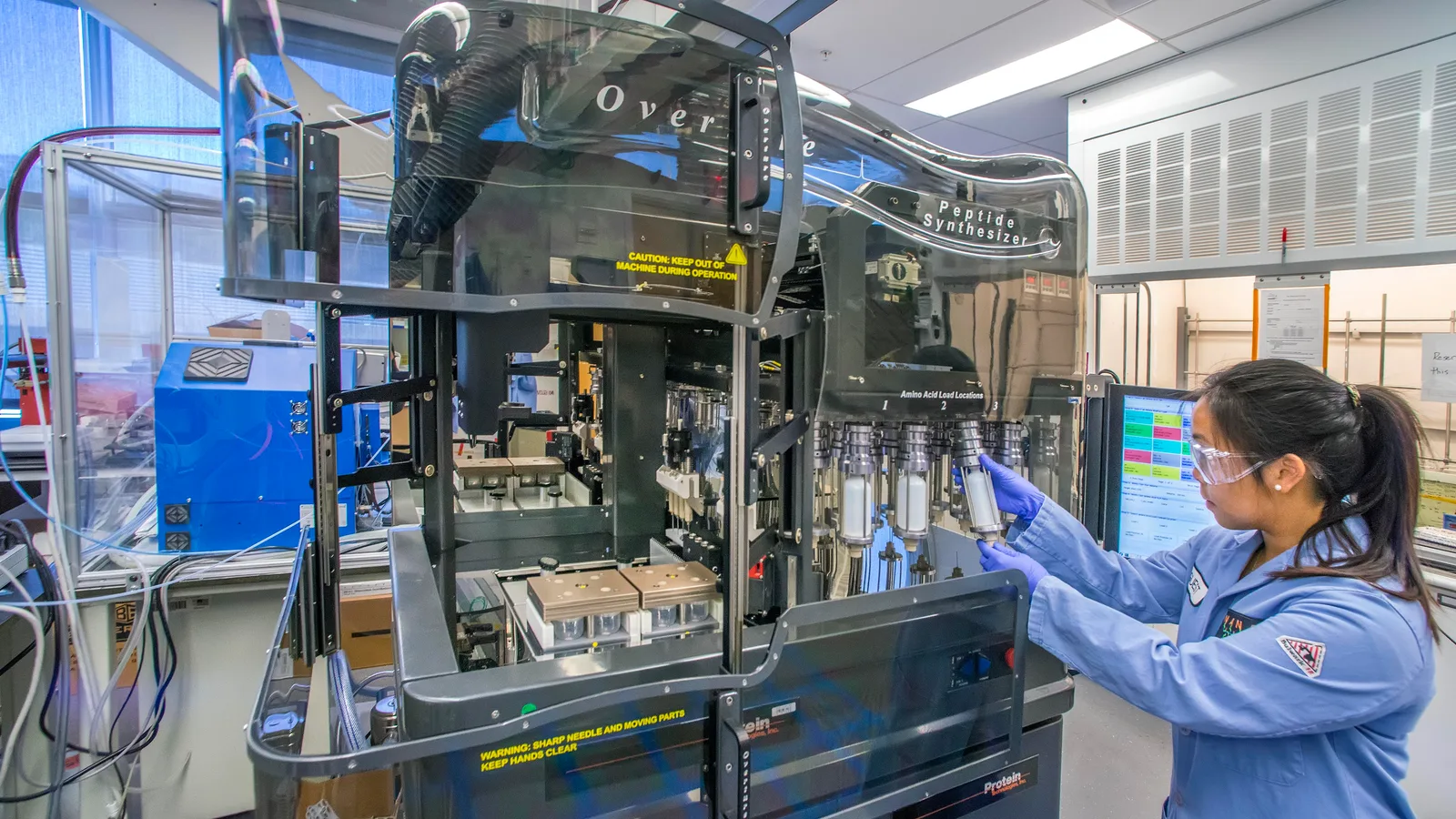
Article39 min read
Why Tirzepatide Is Difficult to Manufacture: Sequence Assembly, Lipidation and Impurity Control
Tirzepatide is a 39-residue peptide carrying a branched C20 lipid side chain on one of its two lysines. No single reaction in its synthesis is unusual — the difficulty is that sequence fidelity, stereochemistry, site-selective lipidation and purification selectivity all have to hold at once. A look at what the published routes and the regulatory record actually say.
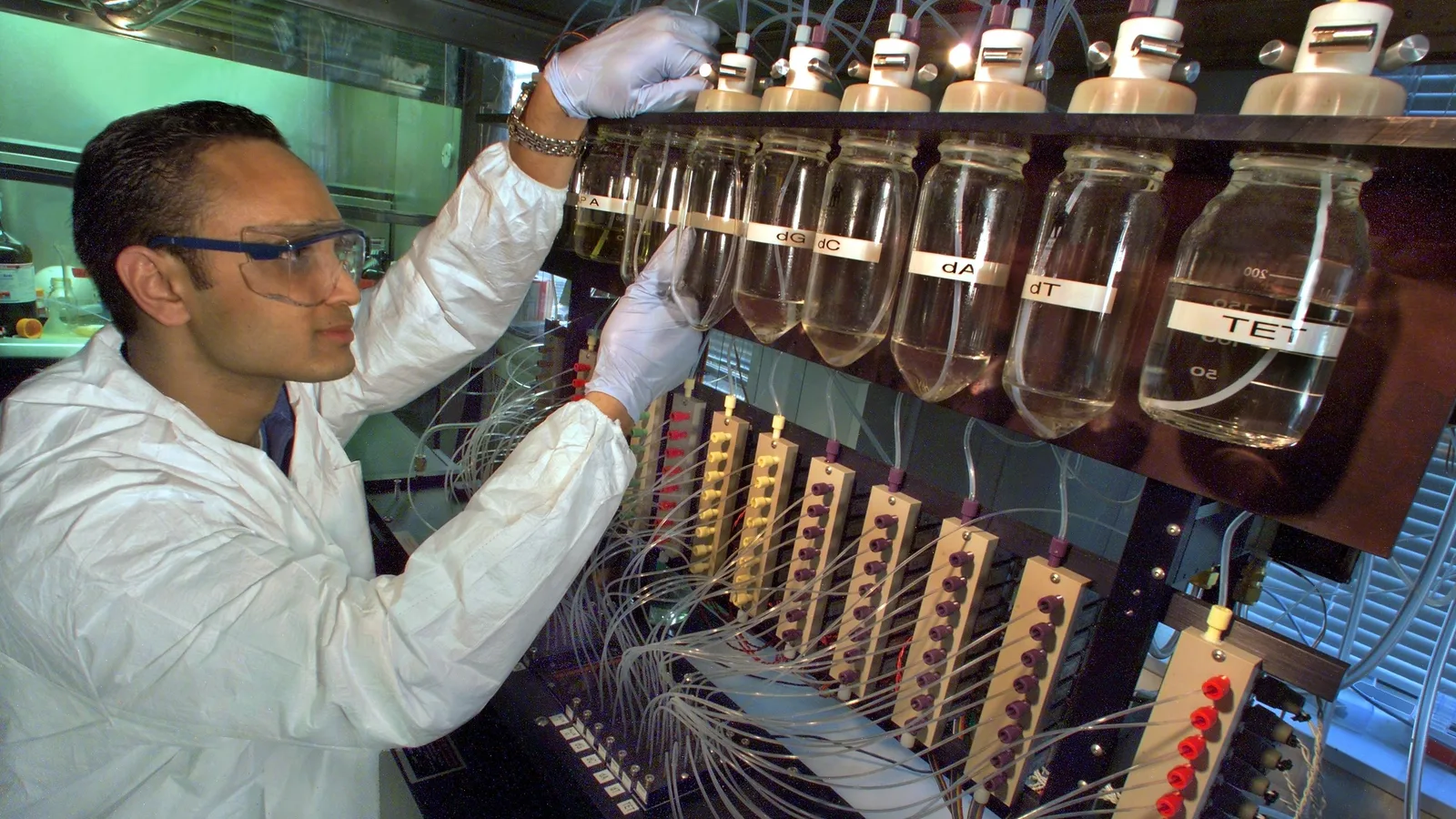
Article39 min read
Why Phosphoramidite Purity Is Not Enough: Impurity Propagation in Oligonucleotide Manufacturing
A phosphoramidite's headline assay does not describe its manufacturing risk. What matters is whether an impurity can be coupled into a growing chain, at which cycle, what sequence variant it creates, and whether purification and analysis can control the result.

Article25 min read
From 1 kg to Commercial Scale: Why Small-Molecule API CDMO Projects Fail During Scale-Up
A practical guide to why small-molecule API CDMO scale-up can fail when laboratory routes meet GMP manufacturing, process safety, impurity control, crystallization, technology transfer and commercial supply constraints.